
 Self-performed shop and field crews
Equipment Access Platforms
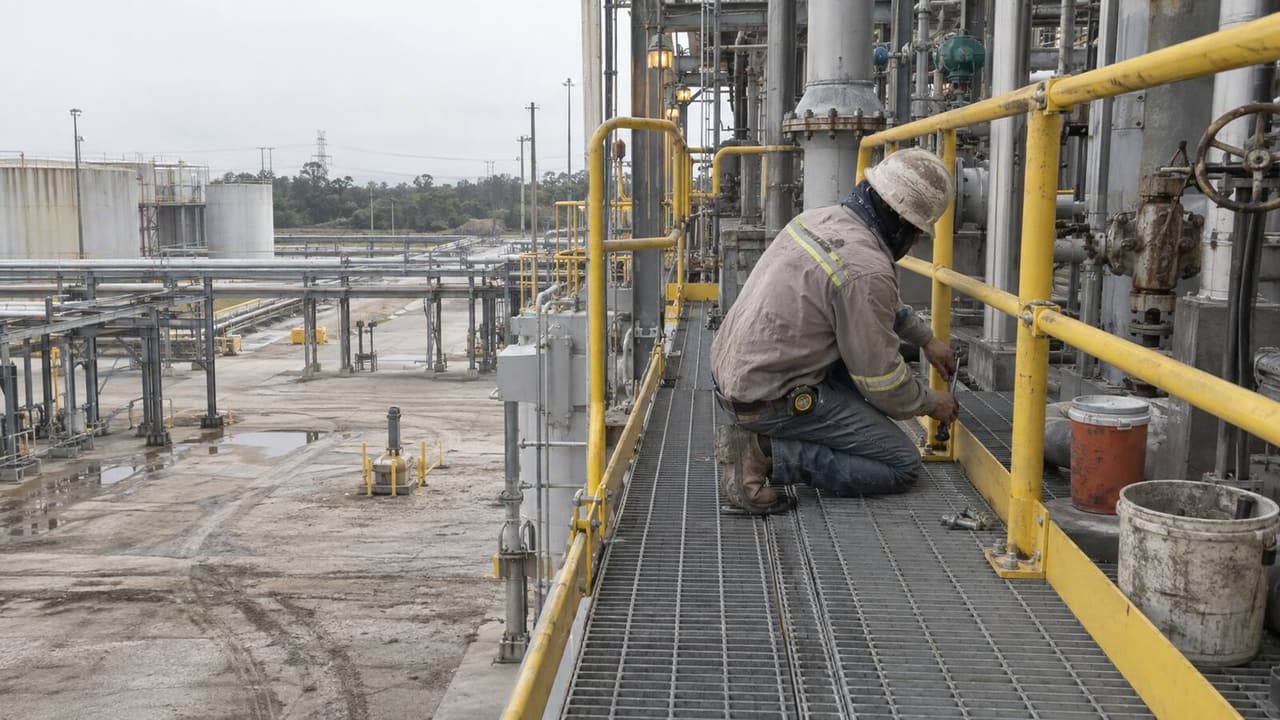
Elevated platforms for valves, motors, filters and sample points. Framed in wide flange or channel, decked in grating, and rated for the load your crew puts on it.
Commercial & Industrial Steel
Industrial access platforms, catwalks, crossovers and ladders for Houston plants, warehouses and process buildings. Detailed to OSHA 1910, welded to AWS D1.1, hot-dip galvanized and installed by our own crews.
Service Overview
Access steel gets built once and used every shift. A guardrail three inches too low, a missing toe board or a catwalk that flexes underfoot will stop an OSHA walkaround cold. Platforms and catwalks detailed to 29 CFR 1910 and load rated on paper fix that. Jimenes Construction is a self-performing steel contractor in Houston, TX, with 23 years on the Gulf Coast. Our own crew measures, welds, coats and installs the access steel your operators and millwrights stand on.
We build for plants, refineries, warehouses and process buildings. That covers equipment access platforms, elevated walkways, pipe and conveyor crossovers, ships ladders and caged fixed ladders. For new floor area inside a building, start on our steel mezzanines page. For egress stair towers and building handrail, see steel stairs and railings.
OSHA sets most of the geometry. Guardrails stand 42 inches give or take 3 inches, and toe boards are at least 3.5 inches tall. Every platform we build carries a design load we can show you. We fabricate the assemblies in the shop, then bolt them to your building frame or your equipment supports in the field.
Coverage
Each of these carries its own geometry, its own load rating and its own inspection. We run all six in house.
Elevated platforms for valves, motors, filters and sample points. Framed in wide flange or channel, decked in grating, and rated for the load your crew puts on it.
Straight runs and switchbacks that link equipment, roof units and mezzanine levels. Handrail, toe board and grating come out of the shop as one assembly.
Stepovers and crossovers that get people over pipe runs, conveyors and curbing. Bolted together so a unit can move when the line changes.
Ship ladders at 50 to 70 degrees for tight access. Fixed ladders with landings, walk-through rails and a ladder safety system where the climb passes 24 feet.
Guardrail at 42 inches with a midrail and a 3.5 inch toe board, built to OSHA 1910.29. Removable sections where a crane has to reach the equipment.
Serrated carbon steel grating, galvanized plank grating and checker plate. Cut, banded and clipped down so nothing lifts underfoot.
Our Process
Five steps, the same on a single pump platform and on a 300-foot catwalk run. Call (832) 576-3278 to start at step one.
We walk the unit with your operators and measure around live equipment. Reach, headroom, egress and the path a maintenance cart takes all get recorded on the spot.
We set the design load, size the framing and grating, then issue shop drawings for your review. Anchor and connection details are settled before any steel is cut.
Members are cut, drilled and welded to AWS D1.1 in our shop. Assemblies then go out for hot-dip galvanizing to ASTM A123 where the service calls for it.
We badge in, pull hot work and confined space permits, and set steel inside your outage window. Bolted connections keep hot work low in process areas.
Guardrail height, toe board, grating clips and ladder clearances get checked against OSHA. Weld records, load ratings and as-built drawings go in the closeout package.
Timeline
Real ranges from our own job records, from field measure to turnover.
| Project Type | Typical Size | Duration |
|---|---|---|
| Ships ladder or caged fixed ladder | 8 - 30 ft rise | 3 - 7 Days |
| Single equipment access platform | 60 - 250 sq ft | 1 - 3 Weeks |
| Pipe or conveyor crossover | 10 - 30 ft span | 1 - 3 Weeks |
| Plant catwalk run | 100 - 300 linear ft | 3 - 6 Weeks |
| Multi-level access structure | 2,000 - 6,000 sq ft | 5 - 10 Weeks |
Engineering & Compliance
Access steel answers to OSHA, to the load your crew puts on it, and to Gulf salt air. We rate every platform and coat it for the room it lives in.
Why Jimenes
Access steel goes wrong at the hand-offs. The same company field measures, details, welds, coats and installs, so the grating drops in the first time.
We have built access steel along the Ship Channel and in Pasadena, Deer Park and Baytown. We know how badging, hot work permits and turnaround windows shape a schedule.
The design load goes on the shop drawing and on a plate at the access point. Your safety team has a number to hand an inspector during a walkaround.
Framing, grating, handrail, toe board, ladders, galvanizing and install each get their own line. Change orders are priced and signed before the crew starts them.
Credentials
Texas does not license steel contractors or general contractors. We send the insurance certificate, welder qualification records and the platform load calculations with every proposal. Here is what a steel contractor in Houston can actually show you.
Where We Work
Headquartered in Houston and building access steel across the Greater Houston area. Our radius runs from inside the 610 Loop east to the Ship Channel plants and out past the Grand Parkway. If you searched for an industrial catwalk or platform contractor near me and landed here, this is the radius we cover. We can walk your site the same week.
Good Questions
Still working out the layout? Call and talk to the person who will field measure your platform.
Talk to a BuilderThere is no square foot rate that holds up across jobs. Six things move the number:
In general industry, fall protection starts at 4 feet under 1910.28. A guardrail system under 1910.29 has a top rail 42 inches above the walking surface, give or take 3 inches, plus a midrail near 21 inches. Toe boards are at least 3.5 inches tall where things can fall on people below. The top rail has to take a 200 pound force in any outward or downward direction. The walking surface itself has to carry the maximum intended load under 1910.22, which is why we put a rating on every platform.
Angle and how often people climb decide it. Standard stairs run 30 to 50 degrees and suit daily traffic with tools. Ship ladders run 50 to 70 degrees and fit where floor space is tight. Fixed ladders run 75 to 90 degrees and suit occasional access only. Fixed ladders installed since November 2018 need a ladder safety system or personal fall arrest above 24 feet, and cages stop counting as fall protection everywhere in 2036. We build all three, and matching building stairs are on our steel stairs and railings page.
Usually not for long. We shop-build the assemblies while the unit runs, then install inside your outage or turnaround window. Bolted connections keep hot work down in process areas, and night or weekend crews work where daytime access is blocked. Our crews carry plant orientation and TWIC badging for Port of Houston facilities.
Along the Ship Channel and in wash-down or process areas, hot-dip galvanizing to ASTM A123 is the safer choice. Salt air and Gulf humidity cut through thin paint film in a few seasons. Indoor dry areas inside a warehouse can run a shop primer and finish coat instead. For heavy chemical exposure we use a duplex system, which is galvanizing with a coating over it.
Yes, and that is most of this work. We field measure the existing steel, check what it can carry, and add framing where the new load needs it. Tie-ins run into pipe racks, equipment supports and building columns. Cutting into a standing frame is covered on our steel repair and field modifications page. If the platform lands on grade, the base plates anchor into a slab or an equipment pad our concrete crews can set. Call (832) 576-3278 and we will come look.
Keep Reading
Access steel rarely travels alone. These are the steel packages that usually ship with it.
OSHA industrial stairs, ship ladders and guardrail that tie straight into the platforms we build.
Learn MoreFree-standing and rack-supported floor levels that add usable square footage inside an existing building.
Learn MoreProcess pipe rack steel with the walkways, ladders and crossovers built into the same package.
Learn MoreFrames, stands and skids that carry pumps, tanks and process equipment where the access steel lands.
Learn MoreBuilt On Integrity. Rated To OSHA.
Free estimates, line-item pricing, and our own crews from the field measure to the last toe board.


 Permitted & Inspected City of Houston and Harris County
 General Liability $2M per occurrence
 Warranty 10-yr structural, 1-yr workmanship


 OR CALL (832) 576-3278