


 Self-performed crews, never brokered
Dock Aprons & Approach Slabs
Heavy-duty aprons and approach slabs where trailers stage and back in, thickened at the dock edge and sloped to drain away from the building.
Commercial & Industrial Concrete
Heavy-duty dock aprons, dock and pit walls, leveler pits and dolly pads for Houston warehouses and distribution yards. High-psi, doweled and thickened at the edge, formed and poured by our own crews.
Service Overview
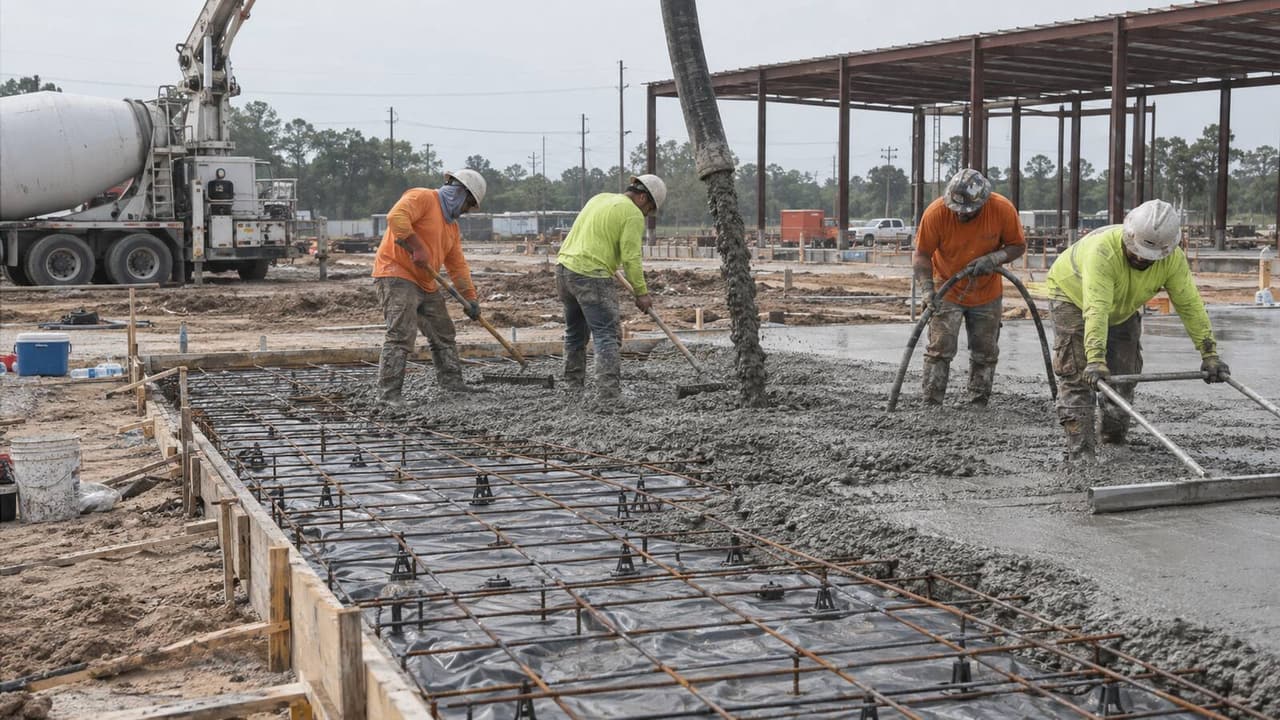
The dock apron carries the heaviest loads on your whole site. Trailer landing gear drives point loads into a few square inches. Jockey trucks brake and turn in the same spot all day. A thin slab on Houston's expansive clay spalls and potholes at the dock face within a year or two. Jimenes Construction pours dock aprons built for that punishment, with a thicker, high-psi, doweled slab engineered for clay that moves. Our own crews form, set steel, drill and pour every job, and we have poured docks on Houston ground for 23 years.
That thicker slab gets a thickened edge at the dock, a higher-strength mix, and doweled joints that move the load across the crack instead of letting one panel drop. Our own crew forms, sets steel, drills and pours, so the apron, the pit walls and the approach slab all get built by the same hands on the same mobilization. On big yards the apron ties straight into our parking lot and commercial paving work so the whole truck court drains and wears as one job.
This is warehouse and distribution work, and Houston has a lot of it along the Ship Channel and the Grand Parkway. We have poured aprons, equipment pads and pits on that ground for 23 years, and we know it moves. Pair the apron with trench and slot drains and the dock stays dry through a 52-inch rain year.
Coverage
Every piece of the dock is its own detail. We crew, form and pour all six in house.
Heavy-duty aprons and approach slabs where trailers stage and back in, thickened at the dock edge and sloped to drain away from the building.
Cast-in-place dock walls, pit walls and curb angles with the steel embeds and bumpers set to the dock leveler and seal drawings.
Formed pits for hydraulic and mechanical levelers, poured to the manufacturer template with the frame anchors cast in and the floor pitched to drain.
Thickened pads that carry parked trailer landing gear and dolly wheels without punching through, placed where trailers drop in the yard.
Reinforced truck court slabs and turning lanes built for loaded rigs and jockey trucks, tied into the apron and the paving.
Doweled construction and contraction joints, thickened edges and full-depth apron replacement where an old slab has spalled at the dock.
Our Process
Five steps, the same on one dock door and on a thirty-door distribution yard. Call (832) 576-3278 to start at step one.
We walk the dock, count the doors, and check trailer type, jockey-truck traffic and where water sits before we set slab thickness and mix.
A line-item quote tied to the plan: slab thickness, thickened-edge detail, psi, dowel and rebar spec, subgrade and drainage each on their own line.
Permit pulled with City of Houston or Harris County, subgrade cut and compacted, pit and wall forms set, dock elevation checked against the building.
Rebar and dowel baskets set over the vapor retarder, leveler and bumper embeds placed to the template, then the pre-pour inspection on site.
One continuous pour, vibrated and hard-troweled. Joints sawn on time, cure applied, embeds checked, and the closeout package handed over.
Timeline
Real ranges from our own job records, from mobilization to final sign-off.
| Project Type | Typical Size | Duration |
|---|---|---|
| Single dock apron repair or replacement | 1 - 2 doors | 3 - 7 Days |
| Dock apron with pit and leveler | 2 - 4 doors | 1 - 2 Weeks |
| Multi-door apron and dock walls | 6 - 12 doors | 2 - 4 Weeks |
| Dolly pads and trailer stands | Yard placement | 1 - 2 Weeks |
| Full truck court and apron package | 20,000 - 60,000 sq ft | 4 - 8 Weeks |
Engineering & Compliance
A dock apron lives on point loads and clay that moves. We detail it for both, off the soil report and your truck counts.
Why Jimenes
Docks fail at the joint between subs: one crew pours the apron, another the walls, another the pit. We do all of it, so the details line up and the load transfers.
The apron sees the heaviest point loads on the site. We set thickness, mix and dowels for loaded landing gear and for jockey trucks that turn in the same spot all day.
Slab thickness, dowel baskets, embeds and pit elevation get checked by the inspector first. Problems get fixed while the forms are still open and the dock is still shipping.
We stage the pours so most of your doors keep running while we work. Line-item pricing, and change orders signed before the work starts.
Credentials
Texas does not license concrete contractors, so we send the insurance certificate and the inspection records with every proposal. Here is what a concrete contractor in Houston can actually show you.
Where We Work
Headquartered in Houston and pouring dock aprons across the Greater Houston area, from the Ship Channel and the Port out along the 180-mile Grand Parkway. If you searched for a loading dock contractor near me and landed here, this is the radius we cover. We can walk your dock the same week.
Good Questions
Still not sure? Call and talk to the person who will run your dock pour.
Talk to a BuilderMost heavy-duty aprons run 8 to 10 inches, thicker than a normal slab, with a thickened edge or haunch at the dock face. The exact number comes off your truck loads and the soil report. We set thickness for landing gear and jockey trucks, then add dowels at the joints so no single panel drops. For the connecting yard slabs, see our parking lot and commercial paving page.
We pour dock aprons at 4,000 to 5,000 psi, higher than a standard slab, because the apron takes concentrated wheel and landing-gear loads. The mix, the rebar and the dowels all get sized to the load. Trucks can use the apron once the concrete gains strength, and we hold heavy traffic off until the 28-day mark.
Three reasons show up over and over in Houston. One is a slab that was too thin for truck loads. The other two are joints with no dowels, which lets panels drop and break at the edge, and a soft or wet subgrade on clay. Water pooling at the dock speeds all of it up. We fix the cause with a thicker doweled slab, doweled joints and drainage that pulls water off the dock face. For the worn concrete itself, see concrete repair and restoration.
Usually yes. We phase the pours so most of your doors keep shipping while we work a few at a time. On a busy Houston distribution yard that phasing is half the job. We map the phasing with you up front and put a pour date on each group of doors.
All of it. Our own crew forms the pit to the leveler template and casts in the frame anchors and bumper embeds. The same crew pours the dock and pit walls and sets the dolly pads out in the yard. One crew keeps the elevations and embeds lined up. We often add trench and slot drains and equipment pads on the same mobilization.
Commercial site and concrete work needs a permit. Inside the city it comes from the City of Houston, and outside city limits from Harris County Engineering or the county you are in. A floodplain lot sets the finished elevation under Chapter 19 or the county rules, which matters at a low dock. We pull the permit and book the inspections. Texas does not license concrete contractors, so ask for the insurance certificate and inspection records instead. Call (832) 576-3278 and we will walk your dock.
Keep Reading
A dock apron rarely travels alone. These are the concrete services that most often run with it.
Truck courts, drive lanes and parking built to carry loaded rigs and tie into the apron.
Learn MoreReinforced pads for compressors, generators and yard equipment, poured with the dock package.
Learn MoreCast-in drainage that keeps the dock and truck court dry through a Houston rain year.
Learn MoreWarehouse floor slabs and structural slabs poured for distribution and industrial buildings.
Learn MoreBuilt On Integrity. Poured To Plan.
Free estimates, line-item pricing, and our own crews from the pit walls to the last trowel.


 Permitted & Inspected City of Houston and Harris County
 General Liability $2M per occurrence
 Workers’ Comp Full crew coverage
 Warranty 10-yr structural, 1-yr workmanship



 OR CALL (832) 576-3278