


 Machines run by our own operators
Excavators & Mini-Excavators With Operator
Digging, trenching, setting pipe and structures, and loading out spoils for plumbing, electrical and utility trades on your schedule.
Jobsite Support for General Contractors
Excavators, skid steers, backhoes and pumps with our own operators, on your site and working under your superintendent. We keep Houston jobs moving through rain, mud and tight trade schedules.
Service Overview
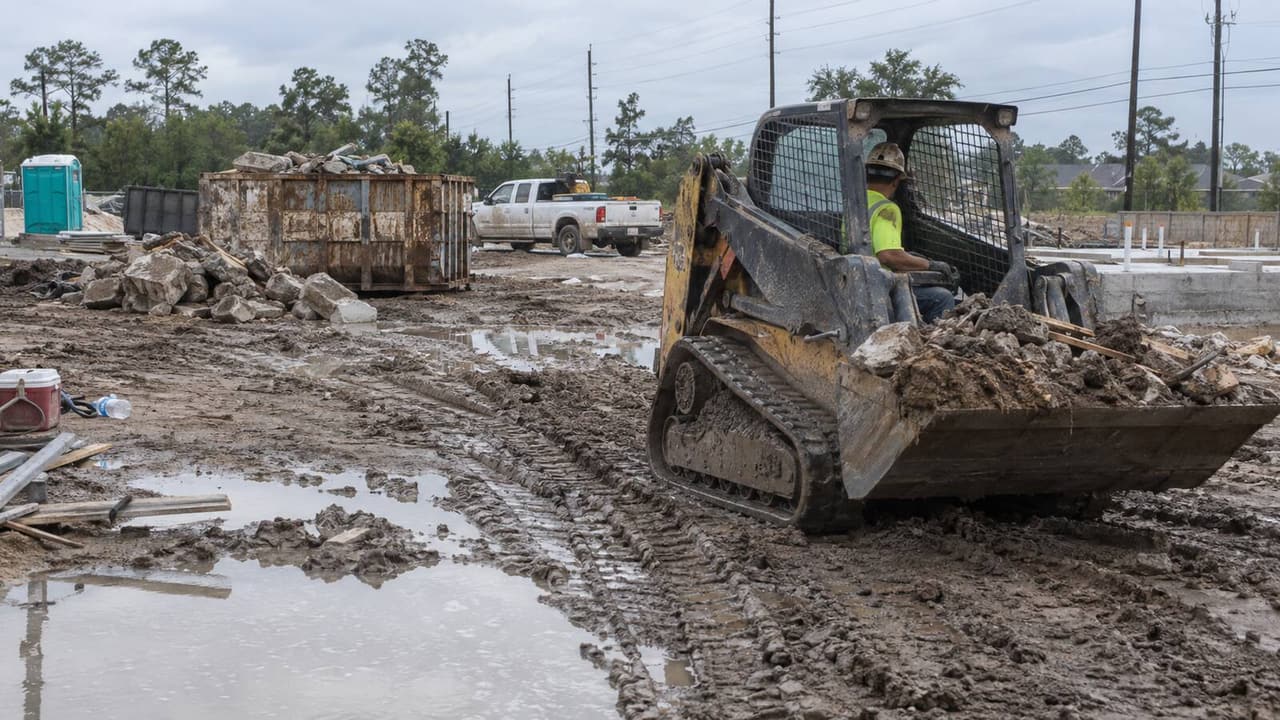
One heavy Houston rain can shut a site down for days. Clay turns to gumbo, trenches fill with water, and every truck drags mud onto the street. Jimenes Construction puts equipment and operators on your job to get it working again. Our own operators run the excavators, skid steers, backhoes and pumps for general contractors, developers and plant owners across Greater Houston.
The setup is simple. The machine, the operator and the fuel come from one sub, and your superintendent directs the work. Some call it a wet rental, or equipment rental with operator. We dig for plumbers and electricians, set pipe and structures, move material, backfill, and load out spoils. Heavier digging runs on our excavation page, and deep or wet trenches on trench safety and shoring.
Rain is the other half of the job. We pump trenches and pads down through a sediment control, because the state permit bars dewatering discharges without one. In Houston, sending it to a street inlet is a city offense under Chapter 47. We rebuild the rock entrance, clear the mud off the street before the next rain, and reset silt fence the machines ran over. Pumps and after-dark work tie into temporary power and site lighting, and haul paths into laydown yards.
Coverage
Each service below sends our own equipment and operator to your site.
Digging, trenching, setting pipe and structures, and loading out spoils for plumbing, electrical and utility trades on your schedule.
Moving base and spoils, backfill, grading touch-up and cleanup, with tracked machines when the clay is too wet for tires.
One machine that digs, loads and carries, for footings, service lines and a GC's punch list of small digs.
Pumping trenches, pits and pads after rain through filter bags or a sediment trap, with a daily discharge log for your SWPPP file.
Rebuilding the rock entrance, scraping and sweeping mud off the street, and resetting silt fence and inlet protection after a storm.
Keeping haul paths, laydown areas and access open, grading ruts, and hauling off debris so every trade can reach its work.
Our Process
Every call runs through the same five steps, whether it is one skid steer for a morning or a full pump-down after a storm. Dial (832) 576-3278 and we get a machine and operator moving.
We walk the site with your super. We check access, ground conditions, open trenches, inlets, and where the pump water is allowed to go.
Machine, operator, mobilization, pumps, hose and filter bags each get a line. You see the hourly or daily rate before we roll.
The operator checks in, joins your safety meeting, and walks the dig with your locate tickets and SWPPP map. Horns and backup alarms get checked before work.
We dig, load, backfill and clean for the trades. After rain we pump down through sediment controls, rebuild the entrance, and get the mud off the street.
Your super signs a daily ticket. Pump logs go into your SWPPP file. The invoice matches the tickets line for line.
Timeline
The rules set the clock after every storm. Here is what has to happen, and how fast.
| Task | Trigger | Deadline |
|---|---|---|
| SWPPP inspection of all controls | Half inch of rain in 24 hours (14-day plan) | Within 24 Hours |
| Competent-person check of open cuts | Heavy rain or runoff into an excavation | Before Crews Re-Enter |
| Dewatering discharge check and log | Any day water is pumped off site | Daily, Report in 24 Hours |
| Mud and sediment off the street | Sediment leaves the site | Before the Next Rain |
| Harris County deficiency fix | County notice, unincorporated areas | Within 72 Hours |
Engineering & Compliance
Houston clay holds water, and water decides whether a site can work. Every pump, machine and entrance we run is set up for that.
Why Jimenes
A rented machine with a stranger in the seat can cost you a day. Our operators come off our own excavation and grading crews, so they read a plan and work around the trades.
Rain on this clay stops more schedules than anything else. We have pumped out and dried in enough Houston sites to know what to fix first.
A freelancing support sub slows the whole job down. Our operators take direction from your superintendent, join your safety meeting, and follow your SWPPP map.
Equipment hours are easy to dispute. Your super signs every daily ticket, and the invoice lists machine, operator, pumps and mobilization line by line.
Credentials
No Texas license exists for equipment operators or site-work firms. Ask any equipment sub for proof of insurance and how its operators were trained. Our certificate of insurance is attached to each quote.
Where We Work
We put equipment and operators on commercial and industrial sites across Greater Houston, all run from our Houston base. That covers the Ship Channel plants from Pasadena to Baytown, the Grand Parkway growth corridor and jobs inside the 610 Loop. Searching for equipment and operators near me? These are the cities our crews reach.
Good Questions
Have a site that needs a machine, a pump or a cleanup? Call the superintendent who will send the operator.
Talk to a BuilderThere is no flat rate. Most operated equipment bills by the hour or the day, usually with a daily minimum and a mobilization charge. The price moves with machine size, attachments, the number of pumps and hoses, filter bags, travel distance, ground conditions, and any overtime or weekend work. We write a line-item quote after a site walk, so you see the equipment and operator cost before we roll. Larger digs are priced on our excavation page.
It depends on your crew. A bare rental puts the operator, the fuel, the damage risk and the OSHA 1926.20(b)(4) qualification on you. An operated rental, sometimes called a wet rental or equipment rental with operator, brings the machine, the operator and the fuel from one sub under their insurance. For a short dig or a rain cleanup, an operated machine is usually the faster call. Ask us to price it either way.
Not if the water is muddy. Houston Sec. 47-741(a) bars any discharge to the storm sewer that is not entirely storm water. The TCEQ construction permit bans dewatering without a sediment control, and it calls for a daily check with a 24-hour report. We pump through filter bags or a sediment trap and follow your SWPPP discharge point. The state permit allows clean groundwater, but the city rule is stricter, so check your SWPPP and the city first. See our SWPPP page for the plan side.
The site operator, usually the GC or owner, under the site SWPPP. Inside Houston, every site of any size must control mud tracking, and inspectors issue a notice of violation, then citations. In unincorporated Harris County, inspectors check the entrance and give you 72 hours to fix what they flag. The state permit says escaped sediment gets cleaned up before the next rain where possible. We rebuild the rock entrance, scrape and sweep the street, and reset inlet protection, which ties into our access roads work.
It depends on the rain total, how saturated the clay is, and whether trenches are open. On the standard 14-day plan, the SWPPP inspection falls within 24 hours of a half inch of rain. OSHA 1926.651(h) keeps crews out of a trench with standing water until it is pumped down and a competent person checks it. Tracked machines and rock or mat haul paths get equipment moving sooner. Working saturated subgrade can ruin the compaction, so some pads need a day to drain.
Texas issues no state license for equipment operators. OSHA 1926.20(b)(4) requires an operator qualified by training or experience, and our operators come off our own excavation and grading crews. Under OSHA 1926.1400(c)(2), excavators, backhoes and loaders sit outside the crane standard, even when they lift with a sling, though the rigging still has to be rated. Our machines carry horns and backup alarms, or work with a spotter. Ask for our insurance certificate with your quote.
Keep Reading
Support work runs alongside the rest of site work. These are the services it most often backs up.
Storm water plans, inspections and the controls a TXR150000 site has to keep up after every rain.
Learn MoreSilt fence, inlet protection and stabilization that hold Houston clay on site through a storm.
Learn MoreRock haul roads and construction entrances that keep trucks moving and mud off the street.
Learn MoreSpoils, debris and excess material loaded out and hauled off so the site stays open.
Learn MoreBuilt On Integrity. Run To Plan.
Free estimates, line-item pricing, and our own operators from the first dig to the last cleanup.



 Permitted & Inspected City of Houston and Harris County
 Workers’ Comp Full crew coverage
 Warranty 1-yr on site work we build



 OR CALL (832) 576-3278