


 Self-performed pipe crews and operators
RCP Storm Mains & Leads
Reinforced concrete pipe, Class III with rubber-gasket joints, from 24-inch inlet leads up to large trunk lines, laid to plan flowlines.
Commercial Site Work
Storm sewer installation for commercial sites, subdivisions and plant expansions across Greater Houston. RCP, box sewer, inlets and manholes laid to your approved plans and ready for City TV inspection.
Service Overview
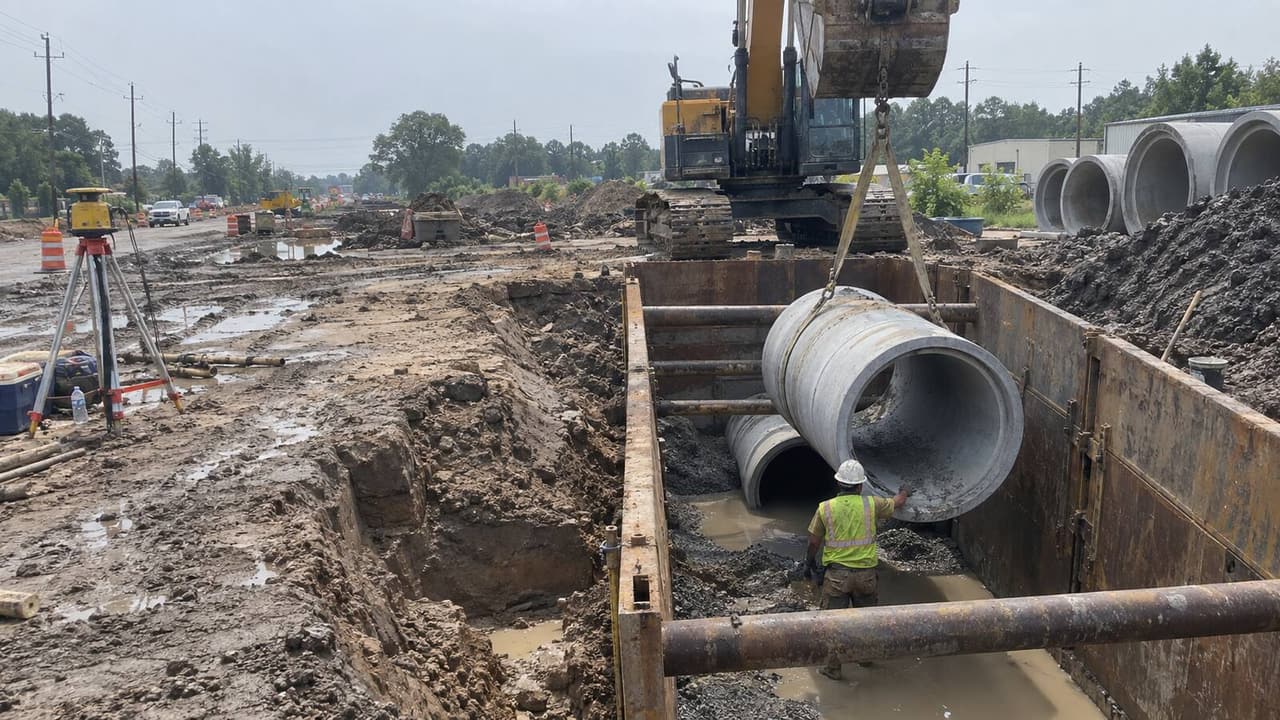
About 52 inches of rain falls on Houston in a normal year, and the flat clay here soaks up very little of it. A commercial site in Houston has to pipe its storm water to the street or a Flood Control ditch. Storm sewer installation is the trenching, pipe, inlets and manholes that move that water away. Jimenes Construction self-performs that work as a storm sewer contractor, with its own operators and pipe crew under a single superintendent. We build to your engineer's sealed plans across Greater Houston, from inside the Loop to plant sites along the Ship Channel.
We build the full system: RCP mains and inlet leads, precast box sewer, curb and area inlets, manholes and junction boxes, and outfalls with headwalls. We tie new lines into the City storm sewer and match them to your detention pond outlet. Our crews can lay your water and sanitary lines on the same job, with the City's required clearance from the storm pipe. The civil engineer of record sizes the pipe and sets the grades. We build the system to those plans. City rules the plans follow: pipe sized for at least the 2-year storm, and a 24-inch minimum for mains and inlet leads. Manholes go at every size or grade change and at least every 700 feet.
Houston ground makes the work hard. Most of the city sits on Beaumont clay that drains slowly, and water often sits close to the surface. Deep trenches fill fast, so we run pumps and set a trench box to keep the cut safe and dry. Pipe sits on compacted bedding with no voids, bells face upstream, and grade is shot with a laser. Nothing is backfilled until the inspector signs off the pipe in the trench. After that the line is TV-inspected, and plastic pipe is mandrel-tested, before the City accepts it. Paving comes once the storm system is in, so we hand off a clean subgrade for parking lot paving.
Coverage
Six parts of a storm system, built by one crew under one superintendent.
Reinforced concrete pipe, Class III with rubber-gasket joints, from 24-inch inlet leads up to large trunk lines, laid to plan flowlines.
Precast box sections set tongue downstream and sealed at every joint, for storm flows too big for round pipe.
City standard curb inlets on streets, plus area drains and catch basins in parking lots and truck courts.
Precast or cast-in-place structures at size changes, grade changes and pipe intersections, with frames and covers set to finished grade.
Outfall pipe, headwalls and erosion protection into roadside ditches, detention ponds and HCFCD channels, with flowlines checked before we set pipe.
Dual-wall HDPE or PP storm pipe where the engineer and the owning agency allow it. Cover depth comes off the plans, and a mandrel test follows backfill.
Our Process
Five steps take a storm line from sealed plans to City acceptance. Call (832) 576-3278 to put your storm sewer on our schedule.
We price from the sealed plans, then line up City storm sewer and street cut permits, HCFCD notices and pipe submittals before we mobilize.
We call the 811 ticket, stake flowlines and structures from the surveyor's control, and stage pumps and a trench box for wet clay.
We start at the downstream end. Bedding is compacted with no voids, bells face upstream, grade is held by laser, and open ends are plugged each night.
Manholes, junction boxes and inlets go in, leads connect square to the wall, and the outfall flowline is checked against the channel.
The inspector signs off the pipe in the trench, we backfill in compacted lifts, then the line is TV-inspected and mandrel-tested for acceptance.
Timeline
Planning ranges from mobilization to City acceptance, based on common storm sewer scopes.
| Project Type | Typical Scope | Duration |
|---|---|---|
| Single inlet or tie-in to a City line | 1 structure, under 100 ft | 2 - 5 Days |
| Retail pad or small parking lot | 300 - 800 ft, 4 - 8 inlets | 1 - 3 Weeks |
| Warehouse or truck court | 1,000 - 3,000 ft, box and RCP | 3 - 6 Weeks |
| Subdivision section | Streets, leads and manholes | 4 - 8 Weeks |
| Outfall into an HCFCD channel | Pipe, headwall, slope repair | 1 - 2 Weeks on site |
Engineering & Compliance
A storm line in Houston is judged twice: by the inspector in the trench, and by the camera after backfill.
Why Jimenes
Storm jobs slip when excavation, pipe and structures are split among subs and nobody owns the grade. Our operators and pipe crew do all of it under one superintendent.
A sag, an open joint or debris on the TV run sends a crew back to dig up buried pipe. We hold grade with a laser, keep bells upstream, plug open ends, and get the inspector's sign-off before backfill.
Miss a 48-hour notice to the City or HCFCD and the work can be forced back open, which holds up the CO. We track the permits and call inspectors before each stage.
Pipe by the linear foot and size, each manhole, inlet and junction box, the outfall, dewatering and trench safety all on their own lines. Any change is priced and signed off before the crew digs it.
Credentials
Texas has no state license for building storm sewer. What a GC or owner can check is coverage, permits and sign-offs. Our bid package carries the insurance certificate and past inspection records.
Where We Work
Headquartered in Houston and building storm sewer from inside the Loop to new industrial parks along the Grand Parkway and the Ship Channel. If you searched for a storm sewer contractor near you, these are the cities our crews work in most.
Good Questions
Holding a set of storm sheets with open questions? Ring the superintendent who would lay the pipe and see it through City acceptance.
Talk to a BuilderOn City public work, reinforced concrete pipe is the standard. It is ASTM C 76, Class III, with rubber-gasket joints. Precast box sewer carries the biggest flows. Plastic pipe is allowed only in set cases.
The City sets a 24-inch minimum inside diameter for storm sewer mains and inlet leads. Box culverts start at 3 feet by 2 feet. The pipe is sized for at least the 2-year storm, with the water level staying below the gutter. Smaller pipe is allowed only in narrow cases, such as a 12-inch private lead into the back of a curb inlet. Your civil engineer sets the actual sizes on the sealed plans, and we build to them.
We price storm sewer from the plans, so we do not quote a per-foot number sight unseen. A short tie-in and a full subdivision run price very differently. These drivers move the storm sewer installation cost:
No. A storm sewer carries rain runoff to ditches, bayous and Flood Control channels, untreated. A sanitary sewer carries waste to a treatment plant. The two systems stay separate by code. The City also wants clearance between the storm line and other utilities, 4 feet to the side and 2 feet vertical. Keeping them apart is part of how the plans get approved.
Connecting a site to a City storm sewer takes a City Storm Sewer Permit. The application needs a street cut permit and one approved plan set less than a year old. Building new storm sewer in City right-of-way takes its own City permit.
Often yes, with HCFCD review. Where the pipe empties into a Flood Control channel, the City manual defers to HCFCD outfall standards. The process runs like this:
Keep Reading
A storm line ties into ponds, trenches and other buried pipe. These pages cover the work around it.
Water, sanitary and fire lines installed alongside your storm system by the same crews.
Learn MorePonds, restrictors and outfall structures that hold back the water your storm sewer collects.
Learn MoreTrench boxes, sloping and daily competent-person checks for deep, wet pipe trenches.
Learn MoreLaid. Inspected. Accepted.
Email the storm sheets and bid date. You get a line-item bid for pipe, structures and outfall, from the first trench to the final TV run.



 Permitted & Inspected City of Houston and Harris County
 Workers’ Comp Full crew coverage



 OR CALL (832) 576-3278