


 Self-performed trenching and pipe crews
Domestic Water Lines & Meter Services
C900 PVC or ductile iron water lines, valves and meter stubs, laid with trace wire and pressure-tested before service.
Commercial Site Utilities
Water, sanitary sewer and conduit for commercial and industrial sites across Greater Houston. Our crews trench, lay, backfill and test to the civil sheets, so paving starts on schedule.
Service Overview
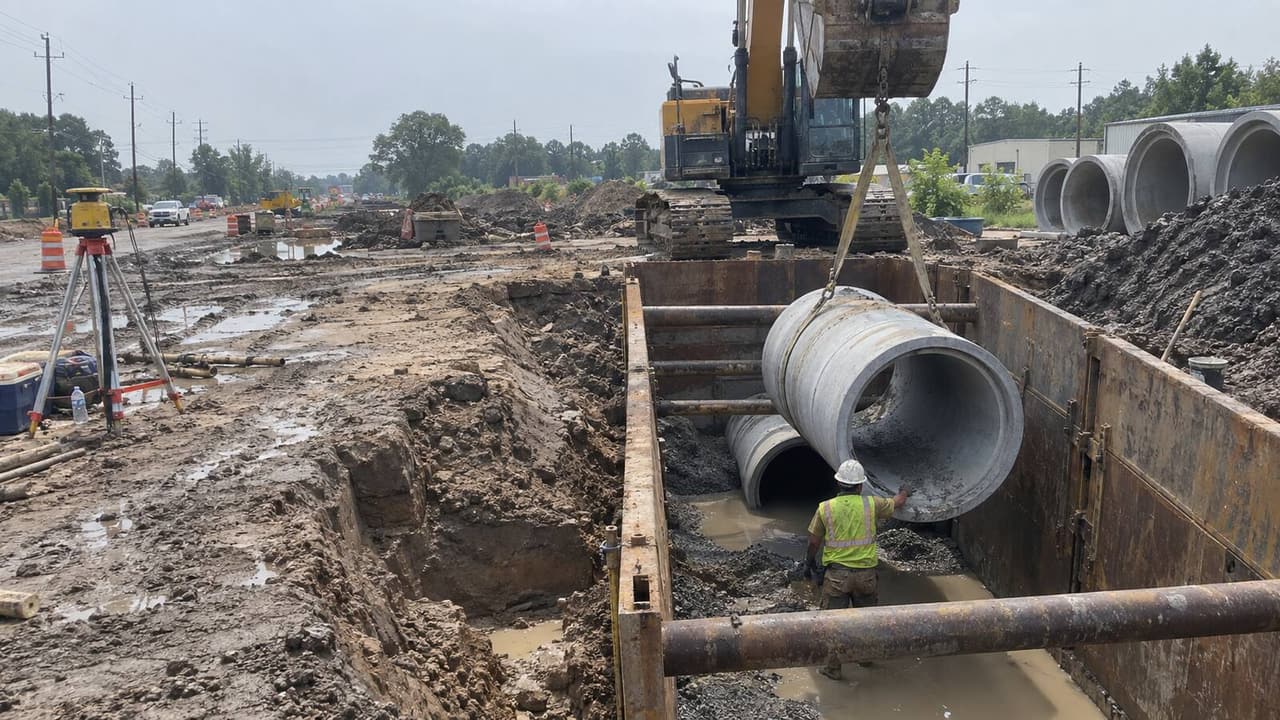
Every Houston building needs water, sewer and power before it can open. Those lines run through wet clay, under future paving, and past pipes already in the ground. Underground utilities are the trenching, pipe laying, backfill and testing that carry service from the main to the building. Jimenes Construction self-performs that work as an underground utility contractor in Houston, TX, with our own operators and one superintendent on every job.
Our crews lay domestic water lines and meter stubs, sanitary sewer mains, services and manholes. We trench and bed the underground fire line alongside your registered fire line contractor. We also build conduit and duct bank for power and data. General contractors, developers and industrial owners hire us with civil sheets in hand. We keep storm drainage on our storm sewer page, deep-trench protection on trench shoring, and mass digging on excavation.
The spec drives every choice. Inside Houston, the work follows City of Houston standard specifications and the Taps and Meters permit. Out in the suburbs, MUD engineers set the plans for water and sewer. Texas rules keep new water lines 9 feet from sewers. Every run is pressure- and mandrel-tested before it is buried for good. We price pipe, fittings, backfill, testing and restoration on their own lines. Paving over the trench comes after the backfill passes, and our commercial paving crew can close it out.
Coverage
Six kinds of underground work on commercial and industrial sites. Our crews dig, lay and backfill all of them.
C900 PVC or ductile iron water lines, valves and meter stubs, laid with trace wire and pressure-tested before service.
Gravity sewer, manholes and building services set to grade, then mandrel-checked and camera-inspected.
Trench, bedding and backfill for the underground fire main, built alongside your State Fire Marshal-registered fire line contractor.
Connections to City of Houston and MUD mains, scheduled with the utility's crew and inspector.
PVC conduit runs and concrete-encased duct bank for power, lighting and data, built to the electrical engineer's drawings.
Sand, select fill or cement-stabilized sand in tested lifts, so paving over the trench does not settle later.
Our Process
Five steps from civil sheets to accepted lines. Send the sheets or call (832) 576-3278 to put locates and layout on the calendar.
We read the civil sheets and pull the City utility maps, file the Texas 811 ticket, and pothole any line we have to cross.
The surveyor's stakes are checked for line and grade. Trenches 5 feet and deeper get a shield or shoring, and wet trenches get dewatering.
Pipe goes on a firm bed, with sand placed by hand around it and compacted in 6-inch lifts. Trace wire goes on every plastic water line.
Trench backfill goes back in lifts to the spec's material. The testing lab checks density before any paving goes over the top.
Water lines are pressure-tested, chlorinated and sampled. Sewer lines are mandrel- and air-tested, then camera-inspected. We make the tie-in with the utility's crew and hand over the records.
Timeline
Planning ranges by project type, from mobilization to final acceptance.
| Project Type | Typical Scope | Duration |
|---|---|---|
| Single-building water and sewer service | Under 300 LF | 1 - 2 Weeks |
| Retail pad or restaurant site utilities | Water, sewer, fire stub | 2 - 4 Weeks |
| Office or warehouse site utilities | Mains, services, conduit | 4 - 8 Weeks |
| Industrial plant utility and duct bank work | Multiple systems | 6 - 12 Weeks |
| Subdivision or MUD section water and sewer | Mains, manholes, services | 8 - 16 Weeks |
Engineering & Compliance
Most utility failures start in the trench. A bad bed or loose backfill shows up later as a leak or a sunken parking lot.
Why Jimenes
When excavation, pipe and backfill are three different subs, bad bedding becomes nobody's fault. Our own crews dig, lay and backfill, and one superintendent owns the test results.
A failed pressure or mandrel test means digging up finished work. We compact in thin lifts, check separation and grade before backfill, and pre-test before the inspector arrives.
Wet clay trenches cave, fill with water and soften underfoot. We dewater, shield, and lay fabric and stone where the spec calls for it, backed by 23 years on this ground.
Lump-sum utility bids hide rock, dewatering and restoration. We give pipe, fittings, bedding, dewatering, testing and paving repair each its own line, and change orders get signed before work starts.
Credentials
Texas licenses plumbers and registers fire line firms, but it has no license for the crews who dig, lay and backfill. Ask any underground utility contractor in Houston for insurance papers and past test reports. Ours go out with every proposal.
Where We Work
Based in Houston and laying site utilities from the Ship Channel plants out to new MUD sections past the Grand Parkway. If you searched for underground utility companies near me, or utility contractors in Houston, this is the ground we cover.
Good Questions
Got a set of civil sheets and a question about the pipe? The superintendent who will lay and test your lines picks up the phone.
Talk to a BuilderMost site utilities go underground on a commercial job. The common ones are:
There is no flat rate, and two sites of the same size can price very differently. The cost drivers are:
Depth comes off the plans for each job. State rules put the top of a water line at least 24 inches below the ground. In City of Houston right-of-way, the design manual calls for 4 feet of cover over a 12-inch or smaller water line, measured from the top of curb. Bigger lines go deeper. Sewer depth follows the grade and slope, so it often runs deeper. Deep trenches need protection, covered on our trench safety and shoring page.
We find lines before the bucket moves. Our steps are:
The tie-in is a shared job. The owner gets a Capacity Reservation Letter and a Taps and Meters permit from the City. On a live City main, the City's crew operates the valves, and we give at least 72 hours' notice for a wet connection. An inspector is on site, and once the line is open we finish the connection in one push. MUD tie-ins follow the district's engineer and operator. Service lines from the building to the main are plumbing under Texas law, so a licensed plumber is part of the job.
Every new line is tested before it is accepted.
Keep Reading
Site utilities rarely run alone. These are the trades that come just before and after the pipe.
Trench boxes, shoring and daily competent-person checks for deep utility trenches.
Learn MoreLaid. Backfilled. Tested.
Email the utility plan sheets. You get back a line-item estimate for pipe, backfill, testing and restoration.



 Permitted & Inspected City of Houston and Harris County
 Warranty 1-yr workmanship



 OR CALL (832) 576-3278