


 Spoil export and fill import in one contract
Dirt Export & Spoil Haul-Off
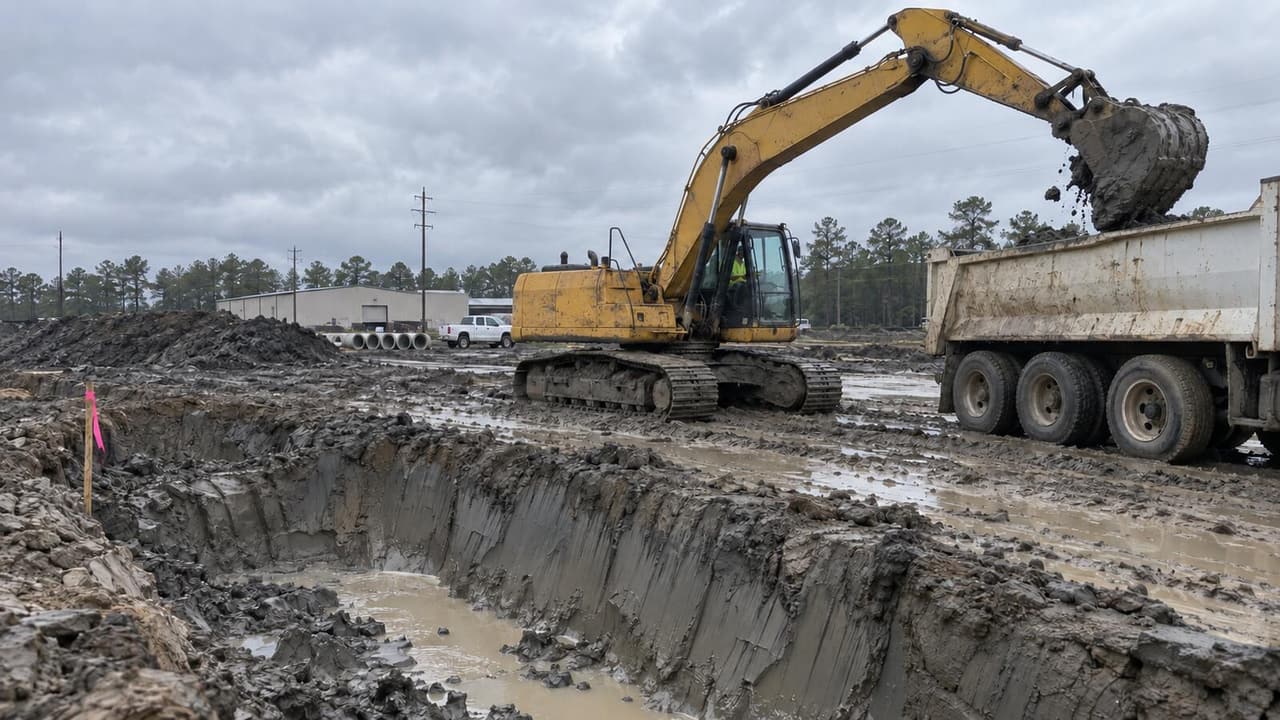
Excess cut, pond spoil and wet clay that failed a proof roll, loaded and hauled to a legal dump site or a job that needs fill.
Commercial Site Work & Hauling
Dirt hauling, fill import and construction debris removal for commercial and industrial sites across Greater Houston. Our crews load the job, track every haul, and take it only to permitted sites.
Service Overview
Every dig on a Houston site makes spoil. Every tear-out makes rubble. Both have to leave on legal trucks, reach a permitted site, and come back on paper. Jimenes Construction runs dirt hauling and construction debris removal as part of our own site work. The crew that digs the site also loads the trucks, tracks the loads, and closes out the haul.
The work runs two directions. On the export side we haul off excess cut, pond and detention spoil, and wet clay that failed a proof roll. That material comes straight from our excavation and detention pond crews. On the import side we bring in select fill, bank sand, cushion sand and flex base for building pads, trench backfill and access roads.
Where the material lands is the part that carries risk. Clean dirt can be reused as fill on a site that needs it. Mixed construction debris goes to a permitted TCEQ Type IV landfill. Stained or odorous soil stops for testing before it moves.
Texas dumping law reaches the site that receives waste as well as the driver, so each load has to land somewhere legal. Rubble from site preparation and tear-outs gets sorted on site and hauled on the same tickets.
Coverage
Dump truck hauling on a commercial job moves in two directions: dirt and debris out, fill and base in. These six hauls cover it.
Excess cut, pond spoil and wet clay that failed a proof roll, loaded and hauled to a legal dump site or a job that needs fill.
Select fill, bank sand and cushion sand brought in to the geotech spec for pads, trench backfill and subgrade.
Flex base and crushed concrete base delivered and spread by belly dump or tailgate for access roads, laydown yards and parking subgrade.
Mixed C&D, brush and rubble from demo and clearing, separated on site and hauled to a permitted TCEQ Type IV landfill.
Broken slabs, curb and old asphalt, with the reinforcing steel pulled, sent to a crusher to come back as base rock.
Scheduled haul-off inside refinery and terminal gates, with badging, escorts and waste profiles set before the first truck arrives.
Our Process
The first truck is booked only after the material, the route and the exit are settled. Call (832) 576-3278 and we will walk the spoil piles with you.
We pull cut and fill numbers off the grading plan and walk the spoil piles. Anything stained, odorous or mixed with trash gets flagged before a single truck is booked.
We plan the haul route to the weight limits and the city truck routes. We check county road and bridge rules, then build the stabilized exit or rumble pad the SWPPP calls for.
We match tandems, tri-axles, end dumps or belly dumps to site access, haul length and material. Trucks are staged so the loader never waits and freeway peaks are missed.
Operators load each truck to legal weight. Every load gets a ticket with the truck, the material and the destination, and the daily count goes to the GC.
Landfill and recycler tickets are matched to the load tickets. The street is swept, the exit comes out when the SWPPP allows, and the closeout package is handed over.
Timeline
These are planning ranges. The dig, the dump site and the weather set the real calendar.
| Project Type | Typical Size | Duration |
|---|---|---|
| Demo debris haul-off, small commercial lot | Under 1 acre | 1 - 3 Days |
| Building pad fill import | 1 - 3 acres | 3 - 7 Days |
| Detention pond spoil export | 2 - 10 acres | 1 - 3 Weeks |
| Mass export, warehouse or subdivision site | 10+ acres | 3 - 8 Weeks |
| Plant turnaround or outage haul-off | Per outage | Set to the outage window |
Engineering & Compliance
A dump truck job runs on weight limits and disposal rules. Both sit on the hauler and on the owner of the site.
Why Jimenes
Split contracts leave a dozer idling while it waits on trucks. Our operators cut, load and place the fill on one schedule, so the machine and the haul stay in step.
Texas law can charge the site that receives dumped waste along with the driver who hauls it. We haul to permitted landfills, recyclers and approved fill sites, and we keep the tickets that prove it.
Haul disputes start with truck counts. Each load carries a ticket, and the invoice ties back to those tickets line by line, so the numbers are easy to check.
One person controls the loader, the trucks, the exit and the street. Mud on the road or an idle truck gets fixed the same hour it shows up.
Credentials
Texas issues no license for dirt haulers. The proof that matters is a current insurance certificate and landfill tickets that match every load we bill.
Where We Work
Based in Houston and hauling across the metro, from the Ship Channel plants at Pasadena and Deer Park to the warehouse corridor along the Grand Parkway. If you searched for a dirt hauling company near me, this is the radius our crews cover.
Good Questions
Have a spoil pile, a demo tear-out or a fill order to price? Call and talk to the superintendent who will run the haul.
Talk to a BuilderIt depends on what the material is. Clean dirt can go to a site that will use it as fill. Mixed construction and demolition debris goes to a permitted TCEQ Type IV landfill. Trash with food or household waste has to go to a Type I. In Texas, dumping 200 pounds or more for pay at an unapproved site is a state jail felony. The site that receives it can be charged too. Fill placed in a floodplain needs its own approval and offsetting storage. We can also reuse clean spoil on your own job. See fill dirt and dirt work for how we place and compact it.
Weight decides it, not the size of the bed. Texas caps a truck at 80,000 pounds gross, with 34,000 on a tandem axle group and 42,000 on a triple. Wet Houston clay hits that weight limit long before the bed looks full. Tight sites and short hauls use tandems or tri-axles. Long hauls use end dumps, and belly dumps windrow base or sand on a road or a pad.
There is no flat rate. The price moves with a handful of drivers.
Yes, when it is clean. The reinforcing steel gets pulled, and the material has to be free of trash and stained soil. TxDOT's Item 247 base spec allows recycled material when the plans call for it. The crushed product must test at 1.5 percent deleterious material or less. Recycling cuts landfill loads and can come back as base rock. We often reuse it on access roads and haul roads on the same job.
We stop the load and isolate the pile. The owner and the engineer are notified, and the soil is sampled and profiled before it moves. Class 1 waste travels on a manifest with a registered transporter, while Class 2 and 3 loads move on a bill of lading. Soil over the Class 1 limits can go only to a Class 1 cell at a Type I landfill. We route hazardous or special waste to a licensed handler and do not haul it ourselves.
It starts with a stabilized construction exit or a rumble pad at the gate. Trucks knock the clay off before they hit the public road, and the street gets swept when tracking shows. Wheel washing is added where the plan calls for it, and controls are inspected on the SWPPP schedule. Our erosion control crews set and maintain those controls.
Keep Reading
Spoil comes from the dig, and imported fill goes into the pad. These services sit on either end of the truck.
Mass cut, trenching and pond digs that produce the spoil we load and haul.
Learn MoreLoaded Right. Hauled Legal.
Free estimates, line-item hauling quotes, and one superintendent from the first load to the last ticket.



 Workers’ Comp Full crew coverage
 Warranty 1-yr workmanship on placed fill



 OR CALL (832) 576-3278