
 Self-performed crews on every pour
Block Foundations for Reciprocating Machines
Massive reinforced blocks for compressors, forging presses and diesel engines, sized so the concrete mass damps the unbalanced forces those machines throw.
Commercial & Industrial Concrete
Reinforced concrete bases for compressors, presses, pumps and mills across the Houston Ship Channel and Grand Parkway plants. Formed, drilled, poured and grouted by our own crews and tuned to the machine.
Service Overview
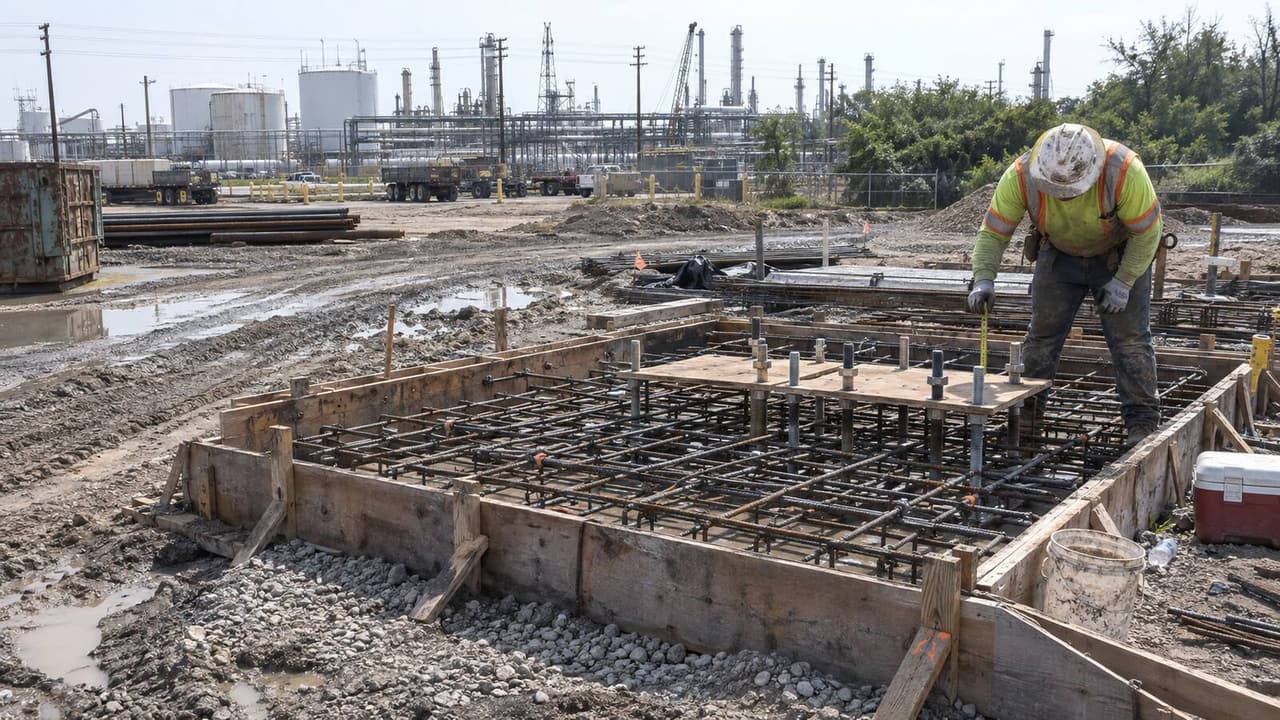
Heavy rotating and reciprocating machines fail at the base long before they fail at the motor. A base that is too light lets the machine move. So does Houston's expansive clay, which swells and shrinks with the weather. Under a compressor, forging press or slurry pump, that movement backs the anchor bolts out, cracks the grout, and spreads vibration into every line and skid bolted nearby.
A machine foundation fixes that for good: a mass of reinforced concrete sized to the dynamic load and tuned so it does not resonate with the machine. Jimenes Construction pours these bases with our own crews, 23 years of them, and engineers each one for Houston clay, from the anchor-bolt template to the final grout.
A machine foundation does a different job than a static equipment pad. The pad carries a load that just sits there, while the block has to hold a machine that shakes, spins or pounds while it runs. We keep every step in house, from the layout crew to the grout crew. We set the anchor-bolt template, drill, pour and grout, and hand the millwright a base that sits flat and stays put.
On high-plasticity clay or under a heavy dynamic load, we carry the block on drilled piers below the active zone, the same way we build a structural concrete foundation. The soil report and the machine data sheet decide the design. We price it line by line, so you can see the block, the piers and the isolation on paper.
Coverage
Each machine loads its base a different way. We crew, form and pour all six in house.
Massive reinforced blocks for compressors, forging presses and diesel engines, sized so the concrete mass damps the unbalanced forces those machines throw.
Blocks carried on drilled piers below the 8 to 20 foot active zone, for high-plasticity clay and soft ground near the Ship Channel and Baytown.
Inertia blocks on spring isolators or elastomeric pads, so the machine's shaking stays in the base and out of the building and the next skid over.
Tuned bases for centrifugal pumps, blowers, fans, motors and small turbines, kept clear of the operating speed so the base does not resonate.
Elevated framed foundations with columns and a top deck for large turbines and generators, where the machine has to sit above pipe and access room.
Anchor-bolt templates, sleeves and embeds set to tight tolerance, then non-shrink or epoxy grout under the sole plate so the machine seats without a shim stack.
Our Process
Five steps, the same on a single pump base and on a compressor block. Call (832) 576-3278 to start at step one.
We pull the machine's weight, speed, unbalanced forces and anchor-bolt drawing from the OEM sheet. Then we read the geotech report, PVR and active zone before we price anything.
The engineer sizes the block or pier group and checks the base's natural frequency against the operating speed. You get a line-item quote: mass, steel, piers, isolation and grout.
Permit pulled with Houston or Harris County, then piers drilled below the active zone. The anchor-bolt template and embeds go in next, set and surveyed to tolerance, then braced.
Rebar mat tied and chaired, then one mass-concrete placement, vibrated tight around the embeds. On big blocks we control the heat so the core does not crack the pour.
Baseplate leveled and grouted with non-shrink or epoxy grout, machine set and bolts torqued, then engineer letters and the anchor survey filed at closeout.
Timeline
Real ranges from our own job records, from mobilization to grout and sign-off.
| Foundation Type | Typical Machine | Duration |
|---|---|---|
| Rotating equipment base | Pump, blower or motor skid | 1 - 2 Weeks |
| Reciprocating compressor block | Gas or air compressor | 2 - 4 Weeks |
| Press or mill foundation | Forging press, roll mill | 3 - 6 Weeks |
| Pier-supported machine block | Heavy machine on clay | 4 - 7 Weeks |
| Table-top turbine foundation | Turbine or generator | 6 - 10 Weeks |
Engineering & Compliance
A machine base has to hold its frequency and its anchor tolerance along with its strength. We design for all three.
Why Jimenes
Machine bases go wrong at the hand-offs: a steel sub, a pump crew, a grout crew. Our own crew sets the template, pours the block and grouts the plate, so nothing is lost between trades.
Most machine base trouble comes from resonance. We size the mass and check the natural frequency against the operating speed, so the base does not shake itself loose.
We survey the anchor-bolt template before the pour and set embeds to the OEM tolerance. The millwright drops the machine on and bolts it down without a shim stack.
The block, the piers, the isolation, the anchors and the grout each get their own line. You see what drives the cost, and change orders are signed before the work.
Credentials
Texas does not license concrete contractors, so we send the insurance certificate and the engineer's letters with every proposal. Here is what a machine foundation contractor in Houston can actually show you.
Where We Work
Headquartered in Houston and pouring machine foundations across the Greater Houston industrial belt, from the Ship Channel and Pasadena out along the Grand Parkway. If you searched for a machine foundation contractor near me and landed here, this is the radius we cover. We can be on site the same week.
Good Questions
Still not sure? Call and talk to the person who will run your machine foundation.
Talk to a BuilderA machine foundation carries a dynamic load: a machine that shakes, spins or pounds while it runs. It is a heavy reinforced block sized and tuned so it does not resonate with the machine, and it holds tight anchor-bolt tolerances. An equipment pad carries a static load, like a tank, a chiller or a transformer that just sits there. If your machine has moving parts and an operating speed, it needs a machine foundation.
There is no flat rate. The dynamic design drives the price. Five things move the cost:
Two ways, and the engineer picks based on the machine and the soil. First, mass: a heavier block damps the shaking on its own. Second, isolation: we set the block on spring isolators or elastomeric pads so the vibration stays in the base and out of the building and the next skid over. On soft ground near the Ship Channel we often carry the block on drilled piers so it does not ride on the clay at all.
A single rotating equipment base can run one to two weeks. A compressor block runs two to four. A pier-supported block or a table-top turbine foundation can run six to ten weeks, because the piers, the mass concrete and the cure all take real time. Two things stretch the schedule: the OEM anchor-bolt drawing, which we need before we set the template, and a plant shutdown window the work has to land inside. You get a dated schedule at contract.
Yes, and the clay is exactly why the design matters here. Much of the soil south of Interstate 10 is expansive, with plasticity index numbers in the 40s and 50s, and the active zone runs about 8 to 20 feet deep. A heavy machine block cannot ride on that ground and stay level. We carry it on drilled piers below the active zone, the same way we build a structural concrete foundation. The geotech report tells us how deep to go.
We do. We build the anchor-bolt template from the OEM drawing and set the bolts and embeds in it. We survey the template before the pour, so nothing shifts while the concrete goes in. We hold the position tolerance the machine builder calls for, which is tight. When the millwright arrives, the baseplate is grouted flat and the machine bolts down without a shim stack. Call (832) 576-3278 and send the anchor-bolt plan.
Keep Reading
A machine base rarely travels alone. These are the concrete services that most often run with it.
Static bases for tanks, chillers, transformers and skids that sit still, poured level and to plan.
Learn MoreBelled and straight-shaft piers drilled below the active zone to carry heavy machine blocks on stable soil.
Learn MoreEngineered slabs, piers and grade beams for buildings and structures on Houston expansive clay.
Learn MoreRegrouting, crack repair and surface restoration for machine bases and industrial concrete that has worn.
Learn MoreBuilt On Integrity. Poured To Plan.
Free estimates, line-item pricing, and our own crews from the anchor template to the final grout.


 Permitted & Inspected City of Houston and Harris County
 General Liability $2M per occurrence
 Workers’ Comp Full crew coverage
 Warranty 10-yr structural, 1-yr workmanship



 OR CALL (832) 576-3278