


 Our own operators, never brokered
Underbrush & Invasive Clearing
Yaupon, Chinese tallow and privet ground down under the canopy, so you can see and walk your land again.
Acreage & Rural Land Clearing
Forestry mulching for wooded acreage north, west and south of Houston. Our operators grind yaupon, tallow and brush into mulch where it stands and leave the hardwoods you want to keep.
Service Overview
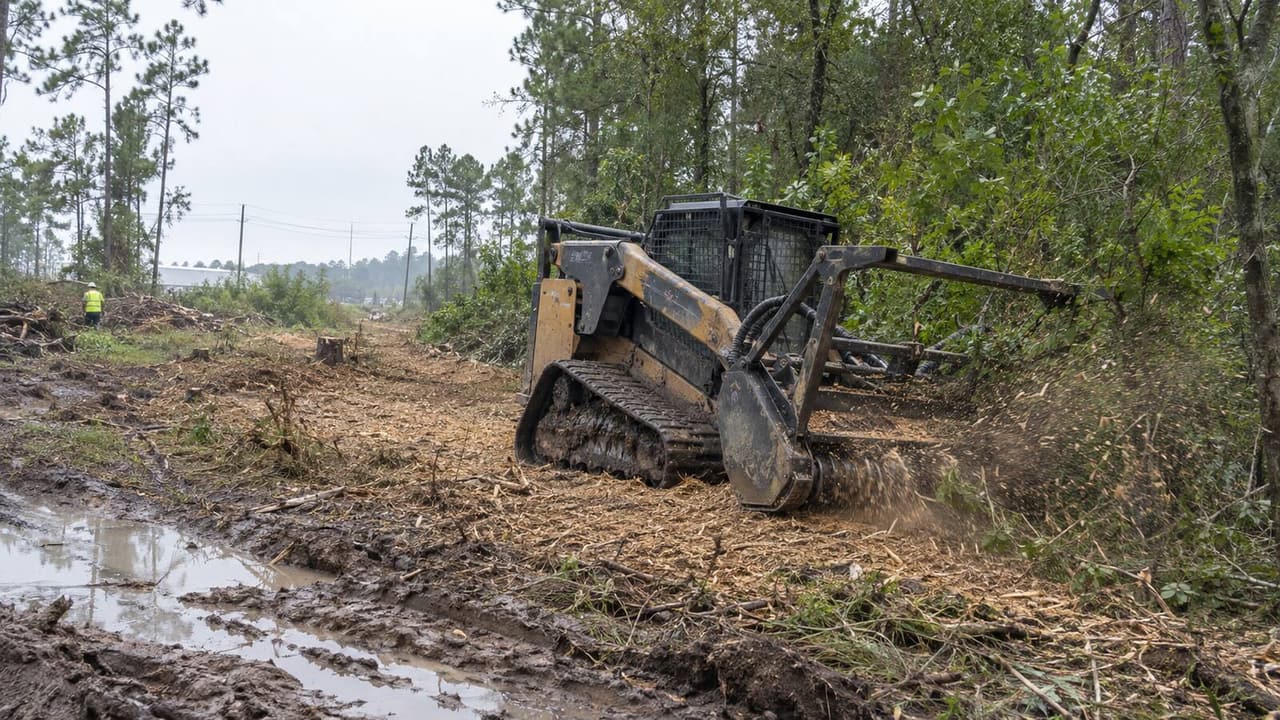
Yaupon, Chinese tallow and privet can close in a wooded Houston-area lot in a few seasons. Forestry mulching opens it back up in one pass, with no burn pile and no haul-off. Jimenes Construction self-performs forestry mulching, with our own operator on the machine and one superintendent on the job.
One machine cuts brush and small trees and grinds them into mulch where they stand. The shredded wood knits into a mat that slows runoff and breaks down into the soil. That is the difference from dozer work, which pushes everything into piles to burn or haul. When a tract needs the stumps and roots out instead, that is land clearing, and we self-perform that too.
Most of our jobs are select clearing. You flag the oaks, pines and pecans you want, and we take the understory around them. Texas A&M Forest Service puts the highest risk of new tallow stands in Southeast Texas, between I-10 and Highway 190. Yaupon grows into thick walls of brush under the pines. Mulching knocks both down. Follow-up is what keeps them down, because they resprout from the roots.
Mulching needs no fire, so a county burn ban does not stop the job. Burn bans in Texas come from the county judge or commissioners court, and Montgomery and Waller counties have both had them in recent dry spells. Texas A&M Forest Service lists mulching as a way to thin the understory for wildfire safety. A building pad or driveway is the exception: that needs stumps and roots out, so see building pads and site preparation.
Coverage
Six jobs we run most on acreage around Houston. Most begin with a walk to mark the keepers.
Yaupon, Chinese tallow and privet ground down under the canopy, so you can see and walk your land again.
We flag the oaks, pines and pecans you want, then mulch around them trunk by trunk.
Brush and vines cleared off an old fence row, or a clean lane opened for a new fence crew.
Walking, ATV and hunting trails, plus a first lane for a future driveway.
Wide mulched breaks and a thinned understory around homes and barns, sized to Texas A&M Forest Service guidance.
Opening a homesite, barn site or view corridor ahead of a builder, before any pad or grubbing work.
Our Process
Five steps from the first walk to the last pass, run by one forestry mulching contractor and crew. Call (832) 576-3278 to set up step one.
We walk the acreage with you, flag the trees to keep, and mark wet spots, creeks, fences and anything buried.
Priced by the real drivers: brush density, largest stems, select or full clearing, access and ground. Each on its own line.
A Texas 811 ticket where the head can reach grade, gates and the trailer route checked, and the ground checked after rain.
The operator works the understory, fence lines and trails, and keeps mulch off the first five feet around any building.
We walk the finished area and talk through resprouts, seeding, and when a second pass or a licensed applicator makes sense.
Timeline
Planning ranges by job type. Density and ground conditions move them the most.
| Project Type | Typical Size | Duration |
|---|---|---|
| Fence line or single trail | Up to 1/4 mile | 1 Day |
| Homesite underbrush clearing | 1 - 2 acres | 1 - 2 Days |
| Select clearing around hardwoods | 3 - 5 acres | 2 - 4 Days |
| Fuel break around home and barns | 2 - 5 acres | 2 - 3 Days |
| Pasture or acreage reclaim | 10 - 20 acres | 1 - 2 Weeks |
Machines & Methods
The right head, the right ground and a plan for what grows back. That is what keeps a mulching job from undoing itself.
Why Jimenes
Many mulching jobs get sold by one outfit and run by another. On our jobs, our own operator runs the machine, and one superintendent answers the phone from the first walk to the last pass.
A mulcher will take a young oak as fast as a yaupon. We flag every keeper with you before the head ever touches the ground.
Tallow, yaupon and privet resprout, and many quotes skip that part. We say so up front, point to AgriLife and TexasInvasives, and plan the follow-up with you.
Per-acre quotes hide the density and access assumptions behind the number. Each driver gets its own price, and any added acreage waits for your signature.
Credentials
Mulching crews need no state license in Texas, which makes insurance the thing to check. Our certificate comes with every proposal, so you can read the limits before you sign.
Where We Work
Based in Houston and mulching wooded acreage in every direction. Magnolia and Montgomery to the north, Waller and Fulshear to the west, Needville and Rosharon to the south, and Cleveland and Huffman to the east. If a forestry mulching near me search brought you here from one of these towns, we can walk your land.
Good Questions
Questions about your acreage? Call, and you will reach the superintendent who flags the keepers and runs the pass.
Talk to a BuilderThere is no flat rate. The forestry mulching cost per acre turns on the drivers we walk with you. Those are brush density, the largest stems, select clearing versus full clearing, and the vine load of greenbrier and grape. Terrain, wet ground, gate and trailer access, and any follow-up pass move it too. Select clearing around hardwoods is slower than taking everything, so it costs more. You get a free line-item estimate after the walk, with each driver priced on its own line. If the land is getting a pad, pond or driveway, see land clearing for full clearing with the stumps out.
It depends on the head and the machine. A disc head fells bigger stems faster and leaves coarser chips. A drum head leaves a finer mulch and can take stumps an inch or two below grade. Head size and machine horsepower set the largest stem it can take. Mature trees past that limit get felled with a saw and handled another way. Tell us the biggest trees in the thicket, and we will confirm at the walk what the mulcher can take.
Yaupon and tallow resprout from the roots, so mulching alone will not kill them. The fix is cut-stump treatment by a licensed applicator, plus a watch on seedlings for a few seasons. We say this up front and plan the follow-up with you. Grass comes back where sun reaches the soil and the mulch is not piled too deep. Seeding after the pass helps it fill in.
The main downside is that the stumps and roots stay in the ground. Buried wood rots and settles, so a mulched lot is not ready for a building pad. A pad or a driveway base needs grubbing and stripping, which is a different job. Wet ground can also limit the work, and the invasives resprout without follow-up. A fresh mulch layer can slow some grass at first. If a pad is the goal, see building pads.
It varies with the density and the ground, so the timeline table above shows planning ranges rather than a fixed rate. Scattered brush moves fast. A solid yaupon thicket with heavy vines moves slowly. Select clearing around keeper trees is slower than taking everything, because the operator works trunk by trunk. Soft ground after a Gulf Coast rain slows it too. We give you a range for your tract after the walk.
It depends on what is growing. A brush hog mows grass and light brush and is often enough for the yearly upkeep of an open pasture. A forestry mulcher takes woody stems and small trees and leaves the ground under a mulch mat. For a fence row or fuel break that has grown into trees, mulching is the tool. Texas A&M Forest Service calls for fuel breaks at least 60 feet wide on flat ground, and mulching builds one without any burning. To turn a mulched trail into an all-weather drive, see gravel driveways.
Keep Reading
Mulching opens the land. These services take it the rest of the way.
Full clearing with the stumps and roots out, for land that is getting a pad, pond or driveway.
Learn MoreBuilt On Integrity. Cleared To Plan.
Free walk-through, line-item pricing and our own operator on the machine, from the first fence row to the last trail.



 Permitted & Inspected City of Houston and Harris County
 Workers’ Comp Full crew coverage
 Warranty 1-yr workmanship



 OR CALL (832) 576-3278