


 Self-performed crews on every pour
Accessible Walkways
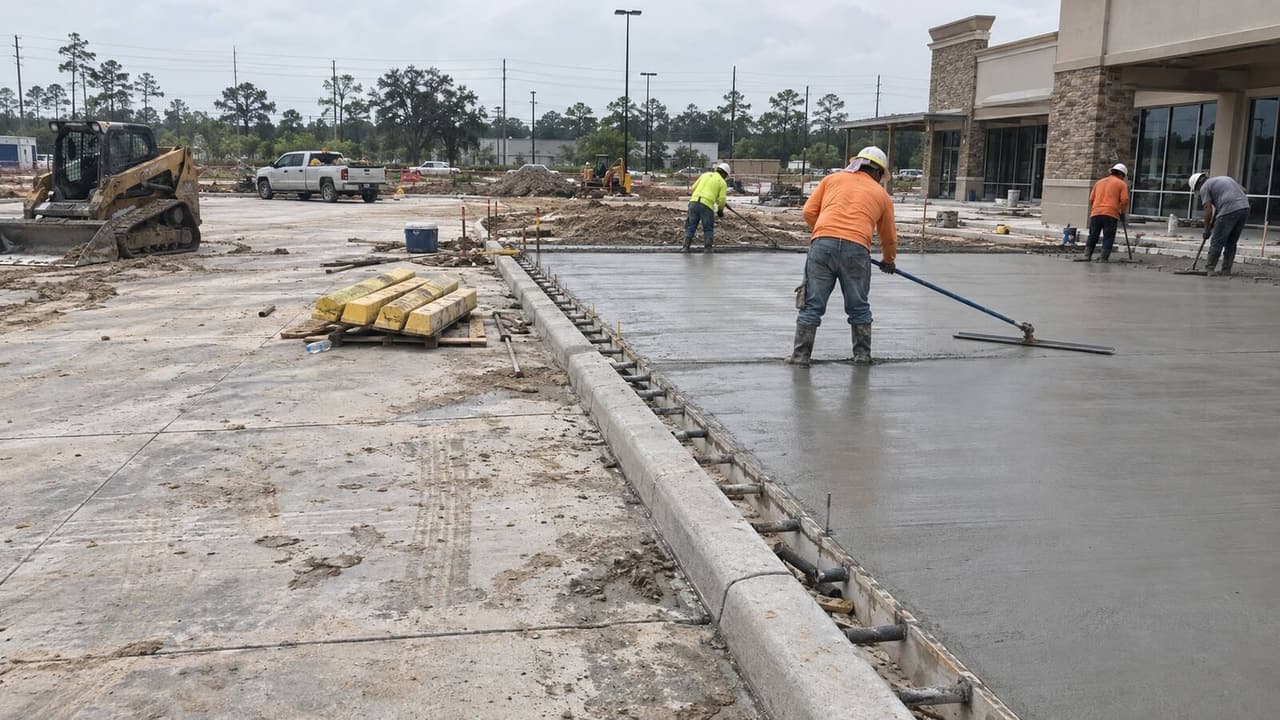
Level routes from parking to the door, held at or under a 5 percent running slope and a 2 percent cross slope. The surface gets a firm, slip-resistant broom finish.
Commercial & Residential Concrete
Accessible ramps, walkways, curb ramps and truncated domes for Houston commercial sites. Formed, poured and finished by our own crews to the slope and cross-slope numbers a plan reviewer checks.
Service Overview
An accessible route passes or fails on numbers you cannot judge by eye. A ramp steeper than 1:12 fails. So does a landing that drains at 3 percent instead of 2, or a curb ramp with no detectable warning. Each one triggers a TDLR citation and a saw-and-repour bill. Houston's expansive clay adds a second risk. Heave can push a slope that passed on pour day out of tolerance a wet season later. Jimenes Construction builds accessible ramps, walkways and curb ramps to those exact numbers with our own crews. We have poured concrete across Greater Houston for 23 years. We form to the ramp and cross-slope angle, prep the sub-base for clay heave, and put a digital level on every run before the inspector arrives.
We build accessible routes to the tape and to the ground underneath them. On projects over $50,000 we coordinate the RAS and TDLR plan review. We hold the pour until the slopes verify. Nothing stalls at closeout, and no one pays to saw out a ramp that missed by a degree.
Most of this work rides with a larger site. We tie accessible routes into sidewalks and walkways, commercial parking lots and building entrances so the whole path of travel reads as one. If an old ramp already fails a survey, our concrete repair and restoration crew rebuilds it to current standards.
Coverage
Each of these has its own slope rule and detail. We form and pour all six in house.
Level routes from parking to the door, held at or under a 5 percent running slope and a 2 percent cross slope. The surface gets a firm, slip-resistant broom finish.
Ramp runs at 1:12 or flatter, with 5 foot level landings top and bottom, edge protection and handrail blockouts set to the plan.
Perpendicular and parallel curb ramps at crossings and parking, with flared sides and gutter slopes that stay inside the counter-slope limit.
Cast-in-place or surface-applied detectable warning panels, full width and set the required depth back from the curb line.
Van and standard stalls with access aisles poured under 2 percent in every direction, tied into the lot and striping plan.
Level landing pads, door maneuvering clearances and threshold transitions at building entrances and between ramp runs.
Our Process
Five steps, the same on a single curb ramp and on a full parking lot accessible route. Call (832) 576-3278 to start at step one.
We shoot grades along the route and mark the high and low points. Then we confirm the path of travel can hold the ADA and TAS slope limits before we price it.
A line-item quote with ramp runs, landings, dome panels and handrail blockouts. On projects over $50,000 we coordinate the RAS and TDLR plan review.
Sub-base cut and compacted, then forms set to the exact ramp and cross-slope angle. The screed line gives the finisher a fixed target to pull to.
One continuous pour, floated and broomed for slip resistance, then truncated domes set and control joints tooled while the concrete is workable.
We put a digital level on every run and landing before the RAS inspection. Anything out of tolerance gets fixed in the forms, and we file the sign-off at closeout.
Timeline
Real ranges from our own job records, from mobilization to slope sign-off.
| Project Type | Typical Size | Duration |
|---|---|---|
| Single curb ramp with domes | 1 - 2 locations | 2 - 4 Days |
| Accessible walkway run | 100 - 400 linear ft | 1 - 2 Weeks |
| Ramp with landings and handrails | 1 - 3 runs | 1 - 2 Weeks |
| Accessible parking and aisles | 4 - 20 stalls | 1 - 3 Weeks |
| Full site path-of-travel upgrade | Multiple routes | 3 - 6 Weeks |
Engineering & Compliance
An accessible route lives or dies on a few numbers. We build to them and check them before the inspector does.
Why Jimenes
An ADA route fails on a fraction of a degree. We form to the exact slope and put a level on every run before the pour, so the RAS inspection is a formality.
The same crew grades, forms, pours, brooms and sets the truncated domes. Nothing gets lost between a paving sub and a flatwork sub.
Clay heave can push a fresh slope out of tolerance in a season. We prep the sub-base and reinforce so the route still passes years later.
Ramps, landings, dome panels, handrail blockouts and tie-ins each get their own line. Change orders are signed before the work starts.
Credentials
Texas does not license concrete contractors, so we send the insurance certificate and the accessibility sign-off with every proposal. Here is what a concrete contractor in Houston can actually show you.
Where We Work
Headquartered in Houston and pouring accessible ramps and walkways across the Greater Houston area, from inside the 610 Loop out past the Grand Parkway. If you searched for an ADA concrete contractor near me and landed here, this is the radius we cover. We can be on site the same week.
Good Questions
Still not sure? Call and talk to the superintendent who will run your accessible route.
Talk to a BuilderThe numbers come from the 2010 ADA Standards and the Texas Accessibility Standards, and they hold everywhere in the state. A ramp run cannot be steeper than 1:12, which is one inch of rise for every foot of length. A walking surface holds a running slope of 5 percent or less, and the cross slope on both stays at or under 2 percent. We form to those exact angles and put a digital level on every run before the pour. See our sidewalks and walkways page for how the route ties together.
In Texas, yes, once the work passes a dollar threshold. Projects with a construction cost over $50,000 must be reviewed by a Registered Accessibility Specialist (RAS) and registered with the Texas Department of Licensing and Regulation (TDLR). The RAS reviews the plans and inspects the finished work. We coordinate that review and hold the pour until the slopes verify. That keeps you from paying to saw out a ramp that missed by a degree.
Because a slope that passes today can fail after a wet season. Houston sits on expansive clay with a plasticity index in the 40s and 50s, and that clay swells and shrinks with moisture. Heave can tilt a curb ramp or landing out of the 2 percent cross-slope window. We prep and compact the sub-base and reinforce the slab so the route holds its numbers. If an existing ramp has already moved, our concrete repair and restoration crew resets it.
Truncated domes are the raised bumps you feel underfoot at a curb ramp. They are a detectable warning for people with low vision, required by ADA and TAS. They must run the full width of the ramp and sit set back the required depth from the curb line or street edge. We install them two ways:
There is no flat rate. A single curb ramp and a full parking-lot path of travel price very differently. The cost moves with the number of ramps and landings, the amount of re-grading, dome panels, handrails, and whether a RAS review is required. We do not publish a price per square foot, because a number given before we shoot the grades is a guess. Ask for the free written estimate, where ramps, domes and tie-ins each get their own line. Curb work often runs with a parking lot repave.
Yes. A lot of our accessible work is retrofit: an old ramp that is too steep, a missing detectable warning, or accessible stalls that drain the wrong way. We survey the current grades, tell you what fails, and rebuild only what has to change. Call (832) 576-3278 and we will walk the site. Bring us the TDLR letter if a reviewer already flagged it.
Keep Reading
An accessible route rarely travels alone. These are the concrete services that most often run with it.
Public and private walks poured to grade and tied into the accessible path of travel.
Learn MoreLots, aisles and accessible stalls poured under 2 percent, striped and drained to plan.
Learn MoreRebuilds for ramps, walks and curbs that have failed a survey or moved on Houston clay.
Learn MoreFormed steps and stair landings that pair with a ramp at entrances and grade changes.
Learn MoreBuilt On Integrity. Poured To Plan.
Free estimates, line-item pricing, and our own crews from the first grade shot to the last truncated dome.



 Permitted & Inspected City of Houston and Harris County
 General Liability $2M per occurrence
 Workers’ Comp Full crew coverage
 Warranty 10-yr structural, 1-yr workmanship



 OR CALL (832) 576-3278