


 Self-performed crew, never brokered
Foundation & Side-Yard French Drains
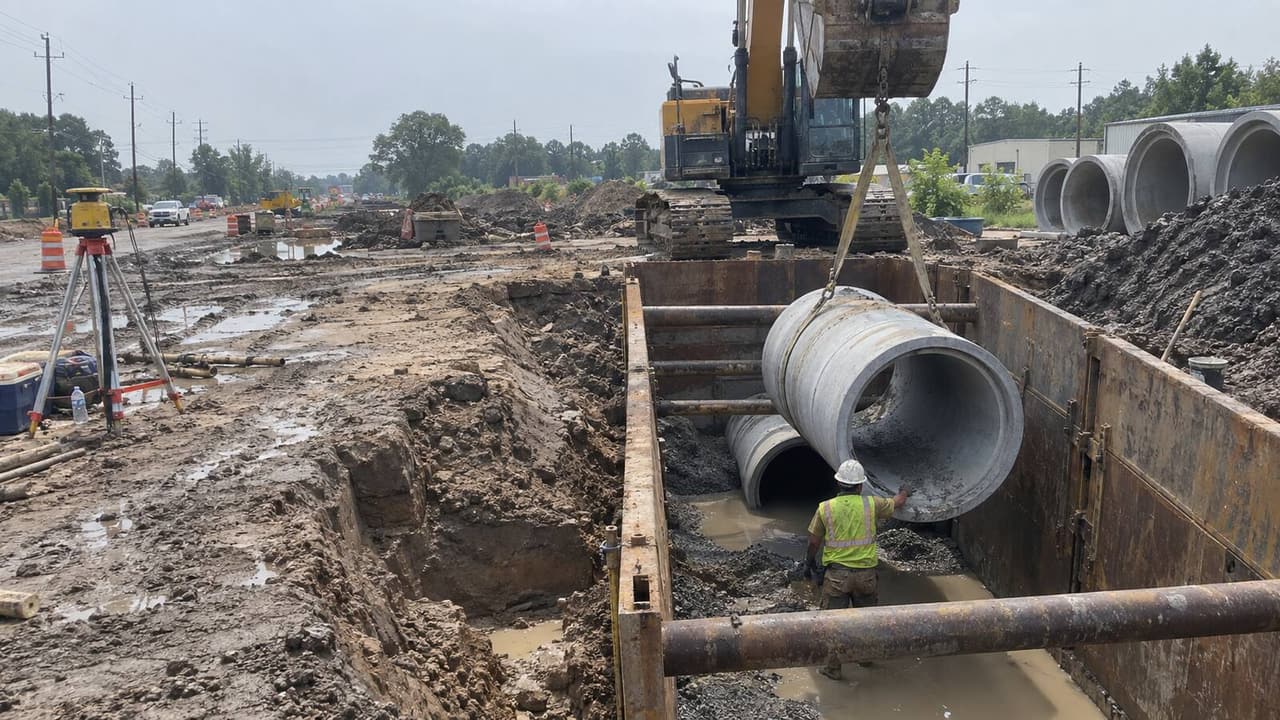
A collector along the foundation edge and the narrow side yard between houses, where Houston lots lose their fall and water sits against the beam.
Residential Drainage & Site Work
French drains for Houston yards that hold water after every storm. Fabric-lined, gravel-bedded and set on steady fall by our own crew, then piped to a legal outlet at the curb, the ditch or a swale.
Service Overview
Houston clay swells shut once it gets wet. The water that cannot soak in sits against your foundation and pools across the lawn. Over the years, that wet clay under the slab is a big part of why so many homes here need foundation repair. A French drain gives that water a path out. Jimenes Construction handles French drain installation across Greater Houston with its own crew, from the first trench cut to the pipe at the curb.
A French drain is a fabric-lined trench with washed gravel and a 4-inch perforated pipe inside. More gravel goes on top, then the fabric folds over it. Solid pipe carries the water from the last collector to the outlet. In Houston it helps most in the narrow side yard between two houses and around a foundation where the grade flattens out. It also works along a driveway edge and behind a retaining wall. For water that runs across the surface, see our yard drainage options, and for sloped lots see our retaining walls.
Here is the honest part. Heavy clays like the Lake Charles series barely pass water once they are wet, so the drain has to carry every drop to an outlet by gravity. It will not soak away underground. Flat Houston lots often have only a few inches of fall to the street, so we shoot grades before we promise one. Where the trouble is surface sheet flow, a swale or a regrade can beat a buried pipe. On open-ditch streets, a driveway culvert may be part of the fix. Every run we build ends at an outlet the City or county allows.
Coverage
Each one solves a different kind of wet. We cut, lay and restore all six in house.
A collector along the foundation edge and the narrow side yard between houses, where Houston lots lose their fall and water sits against the beam.
Trenches through low, soggy turf that stays wet for days in clay, tied to solid pipe that carries the water out of the yard.
Perforated pipe and gravel behind a wall or across a slope, to catch water before it pushes on the wall or crosses the yard.
Runs along a driveway or patio edge that sheds water toward the house or the garage.
Solid pipe to a 4-inch curb outlet, a roadside ditch, a swale, or a pop-up emitter where the grade allows it.
Clogged or crushed runs found, then flushed through cleanouts or rebuilt with new fabric and clean rock.
Our Process
A short side-yard run and a full perimeter system go through the same five steps. Call (832) 576-3278 and we start with a rain walk.
We look at where water stands and where it comes from, then shoot elevations from the wet spot to the street or ditch. No fall, no French drain, and we will tell you so.
Trench footage, pipe, fabric, rock, outlet type, cleanouts, sod and any permit work, each on its own line.
Texas 811 called, sprinklers and utilities flagged, the outlet approved with the City or county, and the run staked on the ground.
Trench cut to grade, fabric laid, washed gravel bedded, perforated pipe set and laser-checked for fall, then wrapped and backfilled.
Solid pipe tied to the outlet, a hose test end to end, then sod, soil or rock put back and the site cleaned up.
Timeline
Planning ranges from the first trench cut to the water test.
| Project Type | Typical Length | Duration |
|---|---|---|
| Downspout or single-run drain | 20 - 60 ft | 1 Day |
| Side-yard drain with curb outlet | 60 - 120 ft | 1 - 2 Days |
| Backyard system with laterals | 120 - 250 ft | 2 - 4 Days |
| Full perimeter drain system | 250 - 400 ft | 3 - 5 Days |
| Acreage or curtain drain to a ditch | 400+ ft | 1 - 2 Weeks |
Engineering & Compliance
Houston clay decides how the drain has to be built. Fall and the outlet matter more than the pipe.
Why Jimenes
Many French drains fail because they were dug by eye with a shovel and a hope. Our operators cut the trench to a laser grade, so the pipe falls the whole way to the outlet.
In Houston clay, a drain without fall just holds water underground. We shoot the grade first, and if a swale or a regrade will work better, that is what we price.
A drain that dumps on the neighbor can land you in a Texas Water Code dispute. Every run ends at a curb, a ditch, a swale or an emitter the site can actually support.
Footage, pipe, fabric, rock, outlet, cleanouts and sod each get a line. You see what the curb outlet costs before you approve it.
Credentials
No state license covers French drain work in Texas. Inside the City of Houston, the plumbing permit for area drains or downspout tie-ins is pulled by a City-registered master plumber. Ask any French drain contractor in Houston for the four items below.
Where We Work
Headquartered in Houston and installing French drains across Greater Houston, from inside the Loop out to Katy, Cypress and The Woodlands. If you searched for a French drain installer near me, this is the ground we cover.
Good Questions
Still not sure a French drain is the right fix? Call and talk to the superintendent who will shoot your grades.
Talk to a BuilderYes, when they work as collectors with fall and a real outlet. Houston clay drinks water fast when it is cracked and dry, then swells shut and barely lets water through. So the drain has to carry the water out by gravity, and it will not soak away. It is the wrong tool for a flat yard with nowhere to send the water. It is also wrong for a buried soak pit or for heavy sheet flow off a neighbor's higher lot. In those cases a swale, a regrade or a catch basin is the better answer. See our yard drainage page for the surface options.
There is no flat rate, because the cost tracks the yard. The price depends on a handful of things.
Depth is set by the wet spot and the outlet elevation, and yard runs often land somewhere around 12 to 24 inches deep. Slope matters more than depth. The pipe needs steady fall of at least 1/8 inch per foot, which is about an inch every 8 feet. We check that fall with a laser before backfill. At the house, code wants the ground to drop 6 inches in the first 10 feet. Where the lot cannot give that, a drain or a swale has to do the job.
It goes to an outlet the City or county allows, never onto the neighbor. On a curb-and-gutter street in Houston, the run ties to a 4-inch Schedule 40 PVC pipe through the curb. On an open-ditch street, the pipe meets the ditch square, below the driveway culvert, with a headwall to stop erosion. A pop-up emitter works only where it sits lower than the inlet with steady fall the whole way. We never tie a drain into the sanitary sewer line. Texas Water Code 11.086 also bars pushing your runoff onto a neighbor. For open-ditch and acreage lots, see our culverts page.
Inside the City of Houston, tying area drains, catch basins or downspouts into a drain line takes a plumbing permit pulled by a City-registered master plumber. Drainage plans the City reviews also have to show an approved outfall, not sheet flow onto the street or the neighbor. Harris County and the suburbs each have their own rules, and an HOA may need to approve a curb outlet or an emitter. We check with your city or county before we dig, so the outlet is settled before the trench is cut.
A French drain lasts when the fabric keeps the clay out, the pipe has fall, and the outlet stays open. Most failures come from no fabric, no fall, a crushed or buried outlet, or tree roots. We flush the run through cleanouts or rebuild it with new fabric and clean rock. If the real problem is a yard that never had the fall to drain, a regrade is the honest fix. Call (832) 576-3278 and we will shoot it and tell you.
Keep Reading
A wet yard rarely has one cause. These are the drainage and site-work trades that most often pair with it.
Swales, catch basins, channel drains and downspout lines for water that runs across the surface.
Learn MoreCulvert pipe under the driveway and clean ditch lines, so an open-ditch lot has somewhere to send its water.
Learn MoreTrenched. Piped. Dry.
Free estimates, grade shots before we promise anything, and our own crew from the first cut to the last roll of sod.



 Permitted & Inspected City of Houston and Harris County
 General Liability $2M per occurrence
 Workers’ Comp Full crew coverage
 Warranty 1-yr workmanship



 OR CALL (832) 576-3278