


 Self-performed crews and operators
Homesite & Acreage Lot Prep
Clear, strip and rough grade a house site on acreage in Montgomery, Waller or Fort Bend County, with the driveway line cut in.
Residential & Commercial Site Work
Site preparation for homesites, shops and commercial pads across Greater Houston. We clear, strip, proof-roll and stabilize the clay, so your builder starts on ground that passes testing.
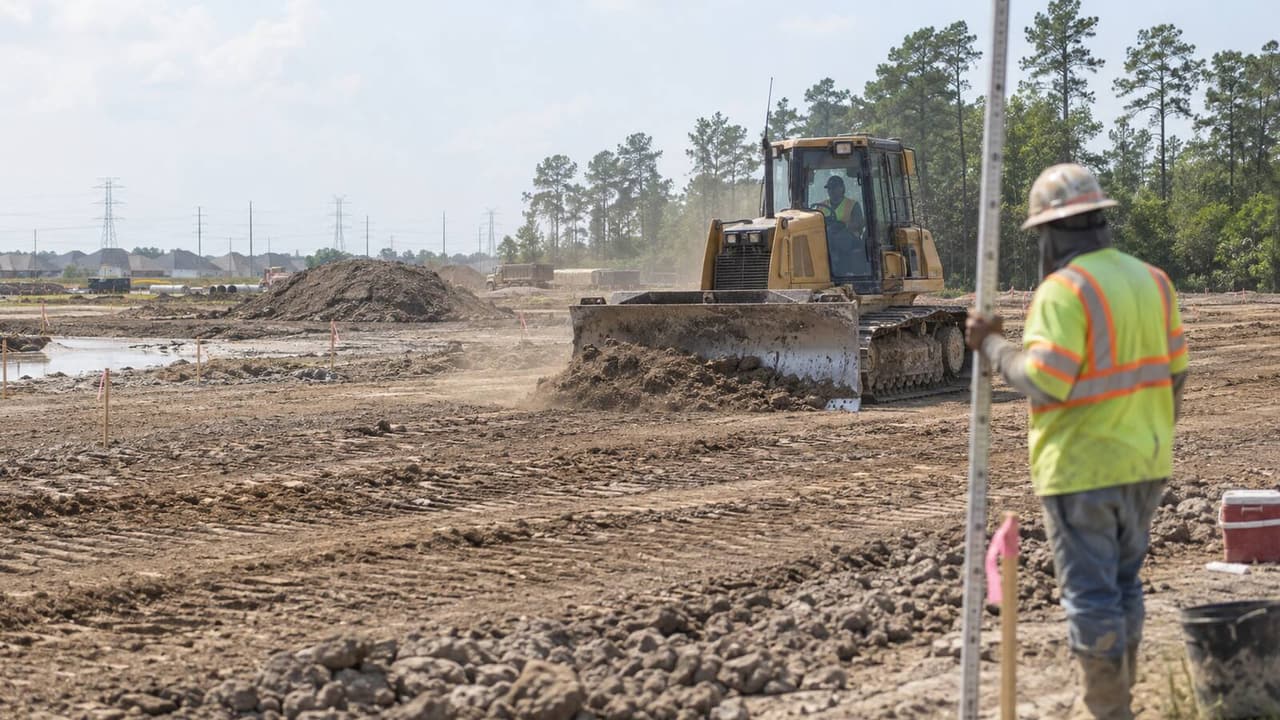
Service Overview
Houston clay holds water, moves with the weather, and hides old stumps and buried fill. Build on it without prep and the pad softens the first wet week. Site preparation is the clearing, stripping, testing and stabilizing that turns raw ground into a subgrade a builder can trust. Jimenes Construction is a self-performing site preparation contractor in Houston, TX, and our own operators run every step with one superintendent on the job.
Site preparation runs in order. We locate utilities and check the surveyor's layout, set erosion controls, clear and grub, then strip and stockpile the topsoil. Next we proof-roll the ground, dig out soft spots, add lime or cement where the report calls for it, and rough grade the site to drain. The steps are the same for a family building on three acres in Magnolia and a general contractor with a five-acre commercial pad on the Grand Parkway. This work sits between land clearing and finish grading, and it ends at the building pad your foundation crew needs.
The soil report drives every choice. Ground north and west of Houston runs sandier, and south and east it is heavier clay. The borings tell us which one your lot has. Fat, high-plasticity clay usually gets lime. Leaner or sandy soil usually gets cement. The lab tests sulfates first, because sulfate-rich soil can heave after lime goes in. On City of Houston work the spec starts at 5 percent lime by dry weight, compacted to 95 percent. We price it line by line, so undercut and stabilization each show up as their own line. When the pad passes testing, we hand it to your foundation crew.
Coverage
Six jobs that happen before anything gets built. Our own crews and operators run all of them.
Clear, strip and rough grade a house site on acreage in Montgomery, Waller or Fort Bend County, with the driveway line cut in.
Strip, proof-roll and stabilize building and paving subgrade to the civil sheets and the geotech report.
Lime for fat clay, cement for lean or sandy soil, mixed to the lab's percentage and compacted to 95 percent Standard Proctor.
Topsoil stripped and stockpiled, stumps and roots grubbed out, soft spots dug out and replaced with select fill.
Silt fence, rock entrances and inlet protection set before the first tree falls, so mud stays on the site.
Texas 811 tickets, private utility checks and grade stakes from your surveyor's plan before a blade touches dirt.
Our Process
A one-acre homesite and a ten-acre commercial pad get the same five steps. Call (832) 576-3278 and the first step is a walk of your site.
We read the geotech report, the borings and the PI results. Then we walk the site for access, trees, old fill and the way water runs off it.
We call the Texas 811 ticket, check the surveyor's stakes, and set silt fence and a rock entrance before clearing starts.
Trees and stumps come out with the roots. Topsoil is stripped, usually 6 inches or more, and stockpiled to spread back later.
A heavy loaded roller or dump truck runs the stripped subgrade. Anything that pumps or ruts gets dug out and replaced with select fill.
Lime or cement is mixed in where the report calls for it, compacted, shaped to drain, and density-tested by the third-party lab.
Timeline
Planning ranges from mobilization to the day the pad passes testing.
| Project Type | Typical Size | Duration |
|---|---|---|
| Shop, barn or barndominium site | 1/2 - 1 acre | 3 - 5 Days |
| Custom homesite on acreage | 1 - 5 acres | 1 - 2 Weeks |
| Residential lot with lime-stabilized pad | 1/4 - 1 acre | 1 - 2 Weeks |
| Commercial building and parking pad | 2 - 10 acres | 3 - 6 Weeks |
| Industrial or multi-building site | 10+ acres | 6 - 12 Weeks |
Engineering & Compliance
Clay that looks dry on top can be soft a foot down. The soil report and the proof-roll tell us which.
Why Jimenes
Prep jobs stall when clearing, dirt work and testing are three different subs. Our own crews clear, strip, stabilize and grade, and one superintendent schedules the lab.
Bids that ignore the report miss the undercut and the lime. Those show up later as change orders. We price the report's recommendations line by line.
A pad that looks fine can pump under a loaded concrete truck. We proof-roll and fix the ground before your builder mobilizes.
Clearing, strip, haul-off, undercut, lime, select fill and testing each get their own line. Extra undercut found at the proof-roll gets priced and signed off before we dig it.
Credentials
No state license exists for site prep in Texas. So every proposal from us carries the insurance certificate, and every finished pad comes with the lab's density reports. These four tiles are the paperwork to ask any site preparation contractor in Houston for.
Where We Work
Based in Houston and preparing sites from inside the Loop to acreage past the Grand Parkway. If you searched for a site preparation contractor near me, this is the ground we cover, in the city and out in the county.
Good Questions
Got a soil report and a question about it? Call and talk to the superintendent who will clear, strip and grade your site.
Talk to a BuilderSite preparation is every step between raw ground and a pad your builder can set on. On a Houston lot it usually runs like this.
There is no flat rate, and two lots the same size can price very differently. These are the things that move the cost.
For anything you build on, yes. The engineer's report sets the strip depth, the lime or cement, and the fill spec. Proof-rolling is the test that follows. We run a heavy loaded roller or dump truck across the stripped ground and watch for spots that pump, rut or flex. Those soft areas get dug out and replaced with select fill before any stabilizing starts. See our building pads page for how we build the pad on top.
The lab decides, but the pattern is steady. High-plasticity clay usually gets lime, which makes the clay easier to work and less likely to swell. Leaner or sandy soil usually gets cement. Sulfates are tested first, because sulfate-rich soil can heave after lime is added. On City of Houston work the spec starts at 5 percent lime by dry weight, compacted to 95 percent. Cement usually runs 6 to 10 percent by weight. The exact number comes off tests on your exposed subgrade.
Clear the building footprint plus a work zone, then strip and grub it. Next, build the pad to the county's required elevation and cut in a driveway and a drainage path. On a manufactured home, the installer has to make sure water drains away from the home, so the pad and the grade matter. A barndominium or metal shop needs the same prepared subgrade a house does. For a metal building on that pad, see our barndominiums page.
Often yes, and it depends on where you are. Inside Houston, a grading permit kicks in for any of these.
Keep Reading
Most prep jobs lead straight into one of these. Each has its own page with the specs.
Select fill pads built in tested lifts for homes, shops and commercial buildings.
Learn MoreSilt fence, entrances and inlet protection that keep your site in compliance.
Learn MoreCleared. Stripped. Tested.
Free estimates, line-item pricing, and our own operators from the first silt fence to the last density test.



 Permitted & Inspected City of Houston and Harris County
 Workers’ Comp Full crew coverage
 Warranty 1-yr workmanship



 OR CALL (832) 576-3278