


 Self-performed operators and equipment
Residential Lot & Yard Grading
Regrade a yard that holds water so it falls away from the slab and drains to the street, ditch or a planned swale.
Residential & Commercial Site Work
Rough and finish grading for house lots, acreage, commercial pads and parking lots across Greater Houston. We cut, fill and shape the ground so rain runs off the site instead of sitting against the slab.
Service Overview
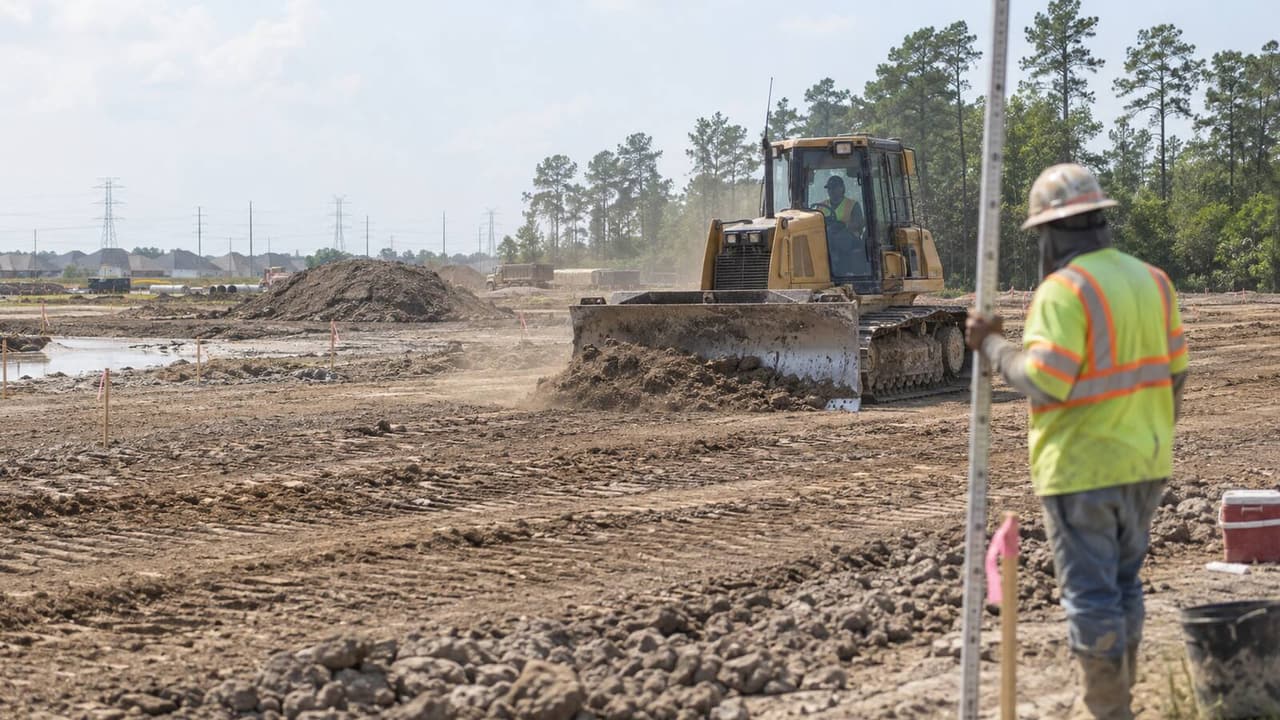
Houston land is nearly flat, and the clay under it barely soaks up rain. Water goes where the grade sends it, or it sits. Grading uses cut, fill and a finish trim to set those slopes to exact elevations. As a self-performing grading contractor, we put our own operators on the machines and one superintendent on each site. That holds from a Katy backyard to a 20-acre commercial pad.
Rough grade moves the bulk of the dirt to within a few inches of plan. Finish grade trims it to about a tenth of a foot. Balancing cut and fill on the same site means less dirt trucked in or hauled off. Grading follows site preparation, runs beside excavation, and sets the base for a raised building pad.
At a house, Houston's code wants the ground to fall at least 6 inches in the first 10 feet. Commercial walls get a 5 percent slope for 10 feet. The slab top sits at least 12 inches above the street gutter, plus 2 percent of the distance to it. In the city, water cannot sheet flow onto a neighbor or the street. We build to your engineer's spot grades and add yard drainage pipe where grade alone falls short.
Coverage
Six grading jobs, from a single yard to a full commercial site.
Regrade a yard that holds water so it falls away from the slab and drains to the street, ditch or a planned swale.
Rebuild the 10 feet around an existing house to code fall with compacted select fill that keeps water off the slab.
Bulk cut and fill to rough grade, then a finish trim to the tenth of a foot before sod, base or paving goes down.
Balance cut and fill across big sites so pads, drives and detention land at plan elevations with less imported dirt.
Shape subgrade so every inlet catches its own area and accessible stalls stay at or under a 2 percent slope.
Pad tops set above the street and flood elevations, sloped to drain, and ready for the foundation crew.
Our Process
A backyard regrade and a commercial site grade run the same five steps. Book the first walk of your lot at (832) 576-3278.
We read the grading plan or take spot shots, then find the outfall: street, ditch, inlet or pond. On a yard, we measure the fall you have now.
Texas 811 gets called, grade stakes or the model go in, and we mark cut and fill so dirt moves the shortest distance.
We move bulk dirt from high to low, place and compact fill in thin lifts, and bring the site within a few inches of plan.
We trim to about a tenth of a foot, with slopes running away from every wall and toward every drain.
We check spot grades against the plan, and the surveyor or engineer verifies where required. Sod, seed or base follows so rain does not undo it.
Timeline
Planning ranges for common grading jobs, counted from move-in to the last grade check.
| Project Type | Typical Size | Duration |
|---|---|---|
| Yard regrade around an existing home | 1 house lot | 1 - 3 Days |
| New home lot grading | 1/4 - 1 acre | 2 - 5 Days |
| Acreage homesite with drive and swales | 1 - 5 acres | 1 - 2 Weeks |
| Commercial pad and parking lot | 2 - 10 acres | 2 - 5 Weeks |
| Mass grading for a development | 10+ acres | 4 - 12 Weeks |
Engineering & Compliance
On flat ground, an inch in the wrong direction decides where the water goes.
Why Jimenes
Grading gets rushed when a day-rate dozer hand leaves before anyone checks it. Our own operators rough and finish grade, and our superintendent checks the spot grades.
Bids that skip the dirt math turn into import and haul-off change orders. We map cut and fill before we price, with import, export and grading on separate lines.
A yard can look level and still drain toward the slab or the neighbor. We grade code fall away from the walls to the outfall on the plan, then confirm it with survey shots.
Clay worked too wet pumps and settles. We dry it back, place it in thin compacted lifts, and use select fill against foundations so the grade holds.
Credentials
No state license exists for grading work in Texas. Ask any grading contractor for proof of coverage instead; ours rides along with the bid.
Where We Work
We grade tight Bellaire lots, Magnolia acreage and commercial sites in between. Searching for grading contractors near me? These are the cities we work in, inside city limits and out in the county.
Good Questions
Weighing a yard regrade or a full site grade? Call, and the superintendent who will set your grade picks up the questions.
Talk to a BuilderA grading contractor shapes land to exact elevations. We cut high spots, fill low spots, compact the fill and finish grade the surface. The goal is water off the site and a level base for sod, paving or a slab. The work runs on dozers, motor graders, skid steers and excavators. Excavation is the separate job of digging down for utilities, ponds and footings.
There is no flat rate, because a yard regrade and a 10-acre site price differently. These move the number:
Houston's home code wants at least 6 inches of fall in the first 10 feet from the walls. Where a fence or neighbor sits too close, a swale or drain carries the water instead. In that case, paving within 10 feet slopes at least 2 percent away. The slab top also sits at least 12 inches above the street gutter. Local foundation engineers warn that sand over clay traps water like a bathtub, so we grade with select fill. Water left against the slab is a common path to foundation repair in Houston.
Rough grading moves the bulk of the dirt to within a few inches of plan, about 0.2 foot under the local engineers' guideline. Finish grading trims to about 0.1 foot, the surface that sod, base or paving sits on. Commercial civil plans set their own tolerance. Under a parking lot, the finished grade hands off to our commercial paving crew.
Both load the target grade into the machine, so the blade knows where to cut. A laser plane suits flat pads and lots. GPS machine control uses the engineer's 3D surface on larger or sloped sites, with fewer stakes and fewer passes. On our jobs, we grade to your surveyor's stakes or model and check the work with survey shots.
It depends on how much dirt moves, and where. In the city, placing more than 50 cubic yards of fill on one lot takes a grading permit. So does fill 3 feet deep, fill over 1 foot under a structure, or a cut deeper than 5 feet. Move more than 1,000 cubic yards and the grading plan needs a Texas engineer's seal. In unincorporated Harris County, new residential lots that change the natural ground need a lot grading plan. City fill below the 500-year flood line has to be offset with matching storage. Erosion control goes in before the first cut.
Keep Reading
Four services we most often book on the same site as a grade.
Clearing, stripping and proof-rolling that get the ground ready before we grade.
Learn MoreSelect fill pads built in tested lifts and set to the right elevation for the slab.
Learn MoreSwales, area drains and pipe for lots where grade alone cannot carry the water.
Learn MoreDigging for utilities, ponds and footings, with spoil moved where the grade needs it.
Learn MoreCut. Filled. Graded to Drain.
Free estimates, line-item pricing, and our own operators from the first stake to the final spot grade.



 Permitted & Inspected City of Houston and Harris County
 General Liability $2M per occurrence
 Workers’ Comp Full crew coverage
 Warranty 1-yr workmanship



 OR CALL (832) 576-3278