


 Silt fence and reinforced fence
Silt Fence & Reinforced Fence
Trenched-in fence on every down-slope edge, wire-backed where water runs in a channel, built to City or HCFCD spec.
Commercial Site Work
Silt fence, rock entrances, inlet protection and hydromulch for commercial and industrial sites across Greater Houston. We install the BMPs, keep them working through the job, and carry the site to final stabilization.
Service Overview
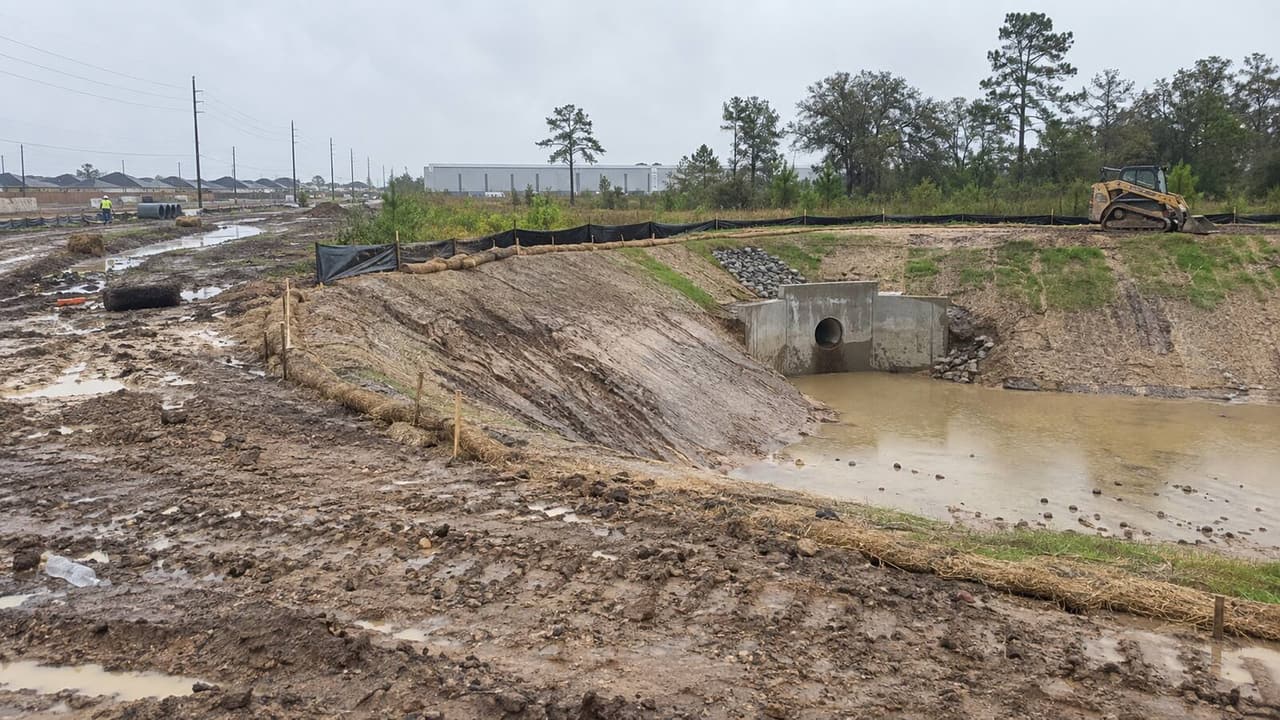
Houston gets about 52 inches of rain in a normal year, and bare clay sheds it fast. One storm can flatten silt fence, fill an inlet and push mud into the street. Erosion control is the fence, rock, inlet protection and ground cover that keep soil on your site and out of the storm sewer. Jimenes Construction is a self-performing erosion control contractor in Houston, TX, with 23 years on this clay. Our own crews install these BMPs and keep them working from the first stake to final stabilization.
Erosion control and sediment control do two different jobs. Erosion controls keep soil in place, like hydromulch, sod and erosion blankets. Sediment controls catch what still moves, like silt fence, sediment logs, traps and inlet protection. The City of Houston requires both on every construction site, no matter the size, to control runoff, sediment to inlets and mud on pavement. The written plan behind the controls, the site notice and the inspection reports live on our SWPPP services page. Controls go in before clearing starts, which ties this work to site preparation and land clearing.
Bare ground does not wait for a dry week. The state rule cleans silt fence before sediment reaches half its height. City basins and HCFCD reinforced fence get cleaned even sooner, at one-third full. Anything a truck runs over gets fixed the day it is found. When work stops on an area for more than 14 days, cover starts by the end of the next work day. We price all of it line by line: fence by the foot, entrances and inlets each, hydromulch by the area. For basin and pond bank work, see detention and retention ponds.
Coverage
Six BMP groups, installed to the civil sheets and kept working by our own crews.
Trenched-in fence on every down-slope edge, wire-backed where water runs in a channel, built to City or HCFCD spec.
Rock on filter fabric at every gate, at least 50 feet long and 8 inches deep on City work, top-dressed as clay fills it in.
Sandbags, gravel bags and steel filter baskets on curb and area inlets, emptied after every storm.
Seed, fiber mulch and tackifier on bare ground, with pegged sod and blankets on slopes and pond banks.
Rock filter dams and sediment logs in ditches and swales to slow water and catch silt before it leaves.
Traps for small drainage areas and basins where 10 or more open acres drain to one point, sized to the plan and cleaned before they fill.
Our Process
Five steps from the first stake to the last fence pulled. Call (832) 576-3278 and we will walk your drainage paths before you bid.
We read the SWP3 site map and civil sheets, then walk the drainage paths, gates, inlets and outfalls with your team.
Perimeter fence, the rock entrance and inlet protection go in before the first tree comes down.
Traps, check dams and diversions move as the dirt moves. We open only the ground the crews can work at once.
After a storm we walk the site, clean fence before it is half full, and fix anything a truck ran over.
Hydromulch, sod or blankets go on finished ground and grow in to 70 percent of native cover. Then the fence and rock come out.
Timeline
Install times are planning ranges. Grow-in and storm maintenance run on top of them.
| Project Type | Typical Scope | Install Time |
|---|---|---|
| Small commercial pad or utility job | Perimeter fence, 1 entrance, a few inlets | 1 - 2 Days |
| Retail or office site | 2 - 5 acres, fence, entrance, inlets, traps | 2 - 4 Days |
| Warehouse or multifamily site | 5 - 20 acres, basins and check dams | 1 - 2 Weeks |
| Industrial plant expansion | Phased controls around live operations | Phased |
| Final hydromulch and stabilization | Finished grades and pond banks | 2 - 4 Days + Grow-In |
Engineering & Compliance
Houston clay turns to mud fast and sheds silt that clogs fabric. The specs below are what keep a site passing inspection.
Why Jimenes
Fence, rock, inlet and cover subs point at each other when a control fails. Our crews install and repair the physical BMPs under one superintendent.
A flattened fence line becomes a finding at the next inspection, or a City notice of violation. We walk the site after storms and repair on the same cycle.
Fine clay blinds fabric and packs a rock entrance fast. We use spec-grade fabric, top-dress rock as it fills, and clean fence before it overtops.
Fence by the foot, entrances and inlets each, hydromulch by the area, maintenance as its own line. Changes are signed before the work starts.
Credentials
Texas issues no license for erosion control crews. What a GC can check is listed here: our insurance, our warranty and who inspects the BMPs we install.
Where We Work
Based in Houston and installing erosion control from inside the 610 Loop out to the Ship Channel and past the Grand Parkway. If you searched for erosion control near me, we cover City of Houston, Harris County and sites built to HCFCD spec.
Good Questions
Have an SWP3 site map and a start date? Call and go over it with the superintendent who will set and maintain your controls.
Talk to a BuilderErosion control keeps bare soil in place with cover like hydromulch, sod and blankets. Sediment control catches soil that still moves, using silt fence, sediment logs, traps and inlet protection. A construction site needs both. The state permit calls for silt fence or an equal control on every down-slope edge of the work. The written plan that ties the controls together is the SWPPP, a separate service we also offer.
There is no flat price. A few things drive the number.
Every gate gets a stabilized construction entrance: open rock on filter fabric. On City work that entrance runs at least 50 feet long, 8 inches deep, and 20 feet wide for two-way trucks. Tires clean off on the rock, and wash water drains to a protected inlet. We shovel or sweep the street daily and keep mud out of the gutter. Longer haul routes inside the site get built as temporary access roads.
Yes. The City of Houston requires controls on every construction site, any size, even one without a SWPPP. City code bans anything but storm water from entering the storm sewer. City inspectors can show up on any site. The first visit brings a notice of violation, and citations follow if the problem is not fixed. In unincorporated Harris County, flagged problems must be corrected within 72 hours. Permit thresholds and filings sit on our SWPPP services page.
The state counts a site as finally stabilized when perennial grass covers at least 70 percent of the native background, evenly, with no big bare spots. Riprap or gabions can stand in where grass will not grow. Ground left idle for more than 14 days needs cover started by the next work day. Houston's hydromulch mix is Bermuda seed, with rye added for fall seeding. The City spec keeps the grass up for 90 days and re-sprays when thin spots pass 20 percent of the area. Once the site is finally stabilized, the fence and rock come out.
A site with 10 or more disturbed acres draining to one point needs a sediment basin where it fits. The permit sizes it to hold runoff from a 2-year, 24-hour storm. Where that cannot be calculated, the floor is 3,600 cubic feet per acre drained. Smaller drainage areas can use sediment traps instead. Basins get cleaned before they are half full, and City basins even sooner, at one-third. Where site water leaves through a pipe or ditch, the outfall gets energy breakers so it does not scour the bank. Natural buffers stay along bayous where possible. The pipe side of that work is on our storm sewer page.
Keep Reading
Controls follow the dirt. These services decide where the dirt goes and how water leaves the site.
The written plan, site notice and inspection reports that pair with the controls we install.
Learn MoreClearing, stripping and proof-rolling, started once the perimeter controls are in.
Learn MoreFenced. Protected. Stabilized.
Send your SWP3 site map for a free line-item estimate. Our crews carry the site from the first silt fence to final stabilization.



 Permitted & Inspected City of Houston and Harris County
 Workers’ Comp Full crew coverage



 OR CALL (832) 576-3278