


 Self-performed crews, never brokered
Custom Home Slabs
Residential post-tension slabs with perimeter and interior beams, poured to a stamped PTI DC10.5 plan for lots with a PVR the engineer will not trust to rebar.
Commercial & Residential Concrete
Post-tension concrete slabs for custom homes, shops and commercial building pads across Greater Houston. Tendons laid to the engineer's PTI DC10.5 plan, poured and stressed by our own crews, with every elongation on record.
Service Overview
Houston sits on high-plasticity clay that swells when it rains and shrinks when it dries. A foundation that cannot handle that movement cracks, and doors and floors go out of level. A post tension slab is built to take it.
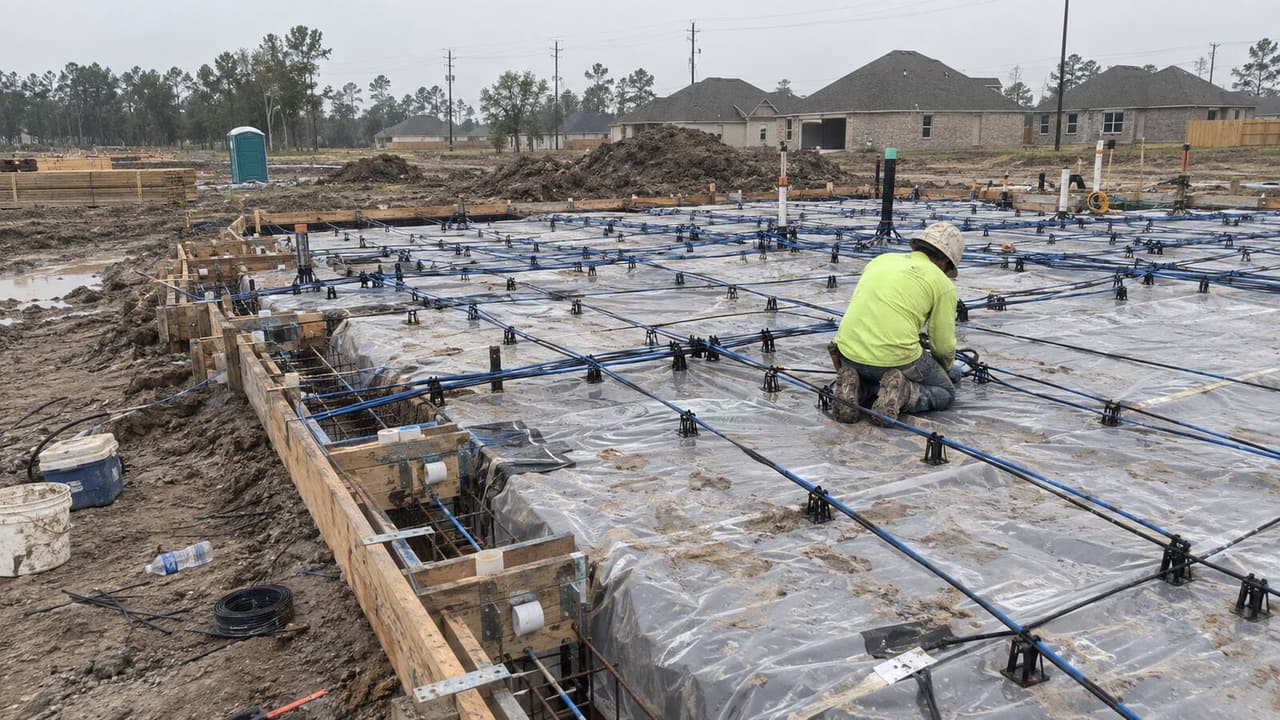
Steel strands run through greased sleeves in the concrete foundation and get pulled tight after the pour. That squeezes the whole slab into one stiff plate that moves with the ground as one piece. Jimenes Construction has been a self-performing post tension slab contractor here for 23 years. Our own crew forms, lays tendons, pours and stresses every slab to the engineer's PTI DC10.5 plan for Houston clay.
That movement is not small, especially south of Interstate 10. Borings around Houston commonly come back with plasticity index numbers in the 40s and 50s, and the soil that shifts with the seasons runs 10 to 25 feet deep. Local geotech reports usually list an edge moisture distance of 4 to 9 feet, and that number sizes the beams. A rebar slab cracks when the edges lift and the middle stays put. A stressed slab bridges that edge lift as one piece, from Katy to Sugar Land.
Jimenes Construction has been a self-performing post tension slab contractor in Houston for 23 years. We read the geotech report and the em and ym numbers before we quote. Our own crew forms, trenches beams, lays tendons, pours, stresses and records. One superintendent runs the job, and the stressing record goes to the engineer before a single tail is cut.
Coverage
Six kinds of post tension concrete slab. We form, lay tendons, pour and stress all six in house.
Residential post-tension slabs with perimeter and interior beams, poured to a stamped PTI DC10.5 plan for lots with a PVR the engineer will not trust to rebar.
Uniform-thickness and ribbed post-tension pads for warehouses, retail and offices, with pour strips and construction joints laid out for long continuous pours.
Post-tension slabs for metal buildings, shops and detached garages, with thickened zones and anchor bolts set where a lift or equipment lands.
Post-tensioned slabs carried on drilled piers for floodplain lots in unincorporated Harris County, where fill cannot be used to raise the pad.
Ribbed slabs where the soil report calls for deep stiffening beams, and uniform-thickness slabs where it does not. The stamped plan tells us which one your lot gets.
Post-tensioned floor slabs that double as the casting bed for tilt-up wall panels on light industrial shells.
Our Process
Post tension slab construction in five steps, the same on a 2,800 square foot house slab and on a 30,000 square foot warehouse pad.
We walk the lot, check truck and pump access, and read the geotech report. The em, ym and PVR numbers tell us what the tendon layout will look like before we price it.
A line-item quote tied to the stamped PTI DC10.5 plan: beam depths, tendon count and spacing, psi, select fill and vapor retarder. Change orders are signed before the work happens.
Permit pulled with the City of Houston or Harris County, and the finished floor set to the flood and manhole rules. Then corners staked, beams trenched, forms braced and anchorages set in the form.
Encapsulated tendons laid on chairs at plan height with the sheath checked for cuts, over a 10 mil vapor retarder. The engineer and inspector sign the pre-pour before concrete is scheduled.
One continuous pour, then cylinders. When strength hits the plan value we stress each tendon, mark and measure the elongation, and send the record to the engineer. Tails are cut and pockets grouted only after sign-off.
Timeline
Typical ranges from mobilization to the engineer's approval of the stressing record. Call (832) 576-3278 for a dated schedule on your lot.
| Project Type | Typical Size | Duration |
|---|---|---|
| Shop or garage post-tension slab | 1,200 - 3,000 sq ft | 1 - 2 Weeks |
| Custom home post-tension slab | 2,500 - 4,500 sq ft | 2 - 3 Weeks |
| PT slab on drilled piers (floodplain) | 2,500 - 4,500 sq ft | 3 - 5 Weeks |
| Commercial post-tension pad | 10,000 - 30,000 sq ft | 4 - 8 Weeks |
| Large pad with pour strips | 30,000+ sq ft | 8 - 12 Weeks |
Engineering & Compliance
Houston clay moves with the weather. Every beam depth, tendon size and spacing on a stressed slab is set to handle that movement.
Why Jimenes
Post-tension slabs go wrong at the hand-off: a forming sub, a tendon sub, a pump crew, a stressing crew that shows up whether the concrete is ready or not. Our own crew forms, lays tendons, pours and stresses, so the sheath does not get cut on day two by someone who was not there on day one.
Most PT slab trouble here starts with a soil report that got ignored. We read the PVR and the edge moisture distance before we quote, then condition the subgrade and set the beams the plan calls for.
A tendon that was under-stressed looks exactly like one that was done right. We mark, measure and log every elongation, and nothing gets cut until the engineer signs the record.
Beams, tendons, psi, select fill and stressing each get their own line. You see what moves the price, and change orders are signed before the work happens.
Credentials
Texas does not license concrete contractors. Ask for the insurance certificate and the stressing records instead. Ours are issued before work begins.
Where We Work
Headquartered in Houston and building post-tension slabs across the Greater Houston area, from inside the 610 Loop out past the Grand Parkway. If you searched for post tension slab contractors near me and landed here, this is the radius we cover. We can walk your lot the same week.
Good Questions
Still not sure? Call and talk to the superintendent who will run your pour and your stressing.
Talk to a BuilderWe quote every post-tension slab per job, after we have read the stamped plan. A per-foot rate given before the soil report is a guess, so we do not publish one. Here is what moves the number: slab size, beam depth and beam count (both set by the PVR), tendon count, psi and select fill. Access matters too, along with the vapor retarder and whether old concrete has to come out. Post tension slab cost versus rebar depends on the ground. On clay with a high plasticity index, a stressed slab often costs about the same as a rebar slab built stiff enough for the same movement. It also uses less concrete in the beams. On stable soil, rebar can be the cheaper call. Ask for the free written estimate and you get every line.
Rebar holds a crack tight after it forms. Tendons squeeze the slab together so cracks are less likely to open in the first place. On clay with a plasticity index in the 40s and 50s and an active zone 10 to 25 feet deep, Houston engineers usually pick post-tension. Now the honest limits. You cannot cut or core a stressed slab without scanning it first. Moving a drain line under it costs more. And a bad stressing job is invisible from the surface, which is why the elongation record matters more than any sales pitch. Where the soil report does not call for tendons, a conventional concrete slab with Grade 60 rebar does the job for less. The stamped plan makes that call.
Houston builds to the 2021 IRC and IBC, effective January 1, 2024. The code calls soil expansive at a plasticity index of 15, and Houston clay is often three times that. The 2021 code Houston uses sends post-tensioned slabs on expansive soil to PTI DC10.5, the Post-Tensioning Institute standard. In Texas a licensed engineer stamps that design, and we build to the stamp. The permit comes from the City of Houston inside city limits. On commercial work the city will issue a Foundation Only Permit so the pad can start during plan review. Outside the city line, the permit comes from the Harris County Engineering Department on Fannin Street. Houston also requires a form survey at the first structural inspection, and the finished floor sits at least 12 inches above the nearest sewer manhole rim. We pull the permit and book the inspections.
Hairline shrinkage cracks are normal and do not mean the tendons failed. Real post tension slab failure almost always starts at the ends. Think of an anchor that was never capped, a sheath cut before the pour, a pocket grouted with the wrong mix, or water reaching bare strand. Trees are the number one cause of foundation repair work in the Houston area, per the Foundation Performance Association, and a slow plumbing leak wets one spot and lifts it. Houston swung from 24.57 inches of rain in 2011 to 79.69 inches in 2017. Clay that sees both is why tendons earn their keep. Watch for doors that stick, a floor out of level, or a tendon end that has popped at the slab edge. Yes, it can be repaired. Piers, leveling and tendon splicing are all real fixes. Start on our foundation repair page or call (832) 576-3278.
Look at the garage floor near the door. A stamp that says post-tension slab, do not cut or core, is your answer. No stamp? Look for round grout patches 1.5 to 3 inches across every 2 to 4 feet along the slab edge. Those are tendon ends. A stressed tendon holds tons of force. Cut one and it can whip out of the slab and hurt someone, and the slab loses the squeeze it was designed for at that spot. So scan before you cut, every time. We locate tendons with ground-penetrating radar before any core, saw cut or plumbing move, then cut between them. Need a floor drain, a lift pocket or a trench in an existing post-tension slab? See our concrete cutting and core drilling page before anyone picks up a saw.
Built to plan and kept at even moisture, a post tension concrete slab lasts the life of the building. The strand is 270 ksi low-relaxation steel, greased and sheathed so water never touches it. Stressing happens once the concrete reaches the strength on the plan. Residential tendons are usually stressed 3 to 10 days after the pour, and owner specs like the University of Houston's say not to stress below 3,000 psi. We mark each strand, pull it, measure how far it moved, and check that number against the engineer's calculation. Tails get cut and pockets get non-shrink grout only after the engineer approves the record. After that, the slab's life is mostly up to the yard. Keep grade sloping 2 to 5 percent away from the slab, fix leaks fast, and keep big trees back from the edge.
Keep Reading
The stressed slab is one piece. These are the services that most often run with it.
Conventional rebar slabs, shop pads and building pads where the soil report does not call for tendons.
Learn MoreDrilled piers under a post-tension slab for floodplain lots and high-PVR sites.
Learn MorePiers, leveling and tendon repair for a post-tension slab that has already moved.
Learn MoreGraded, compacted and select-fill pads built to the elevation your post-tension slab needs.
Learn MoreBuilt On Integrity. Stressed To Plan.
Free estimates, line-item pricing, and our own crews from forms to the final stressing record.



 Permitted & Inspected City of Houston and Harris County
 General Liability $2M per occurrence
 Workers’ Comp Full crew coverage
 Warranty 10-yr structural, 1-yr workmanship



 OR CALL (832) 576-3278