

 Self-performed crews on every wall
Cantilever Retaining Walls
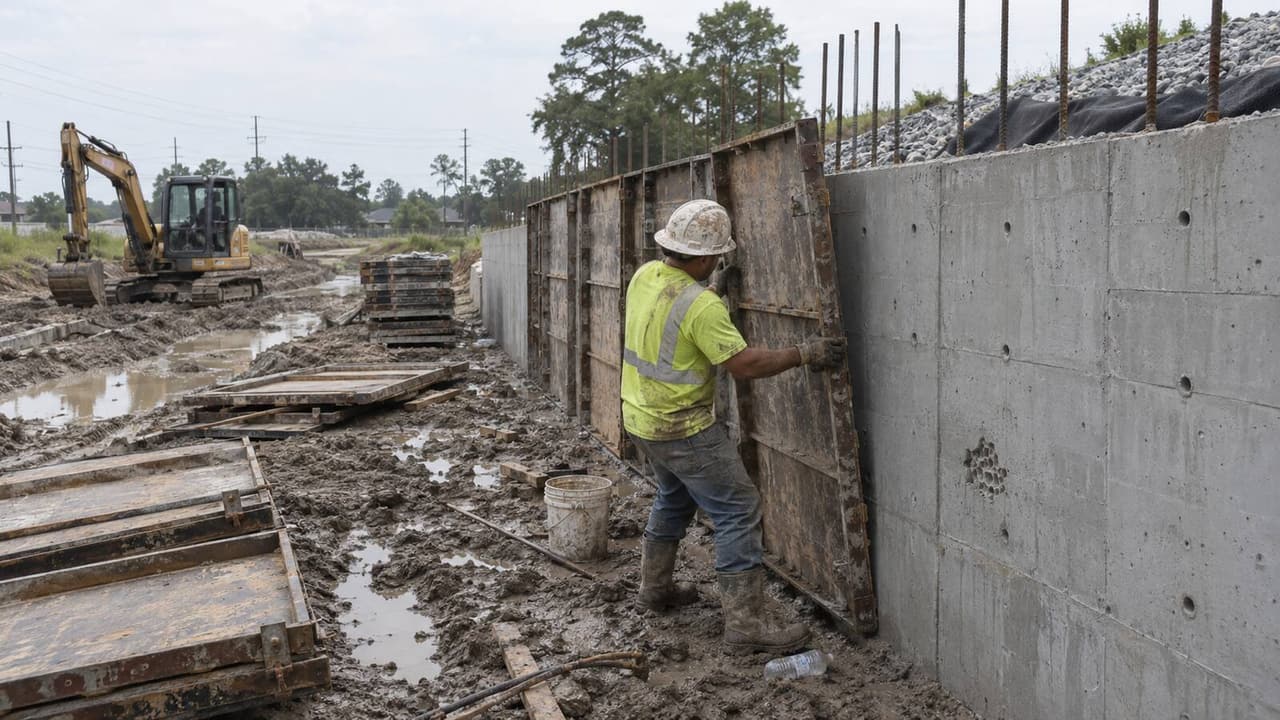
Cast-in-place L or T walls that use their own footing and the soil weight on top to hold back grade. The workhorse wall for Houston yards, driveways and split-level lots.
Commercial & Residential Concrete
Cast-in-place concrete retaining and screen walls with engineered drainage, formed and poured by our own crews. Built to hold back saturated Houston clay after a Gulf Coast storm.
Service Overview
A leaning, cracked or bulging retaining wall is a sign the water won. After a Houston storm, saturated clay behind a wall gets heavy and pushes with real force. If that water has nowhere to drain, the pressure keeps building. The wall then tips, slides or breaks apart. A cast-in-place concrete retaining wall built with engineered drainage carries that load and lets the water out. Jimenes Construction is a self-performing concrete contractor with 23 years on the Gulf Coast. Our own crew drills the footings, sets the steel, forms the stem and pours the wall in one piece. The weep holes and drain rock go in from the start.
No brokered crews, no hand-off between a footing sub and a wall crew. That is how we build the part you never see: the weep holes, the drain rock and the geo-drain that keep pressure off the wall. A well-drained wall rests on solid ground, so we tie it to the same engineered approach we use on concrete foundations and drilled piers.
Height decides how much engineering a wall needs. Under the IRC, a wall over 4 feet, measured from the bottom of the footing to the top, has to be designed by an engineer. So does any wall that holds back a slope or a surcharge load like a driveway. We build both the short garden walls and the tall engineered ones, plus screen walls, planter walls and detention-pond banks. Where a wall meets the street, we tie in the curbs and gutters so runoff has a clean path.
Coverage
Each wall type carries load a different way. We form and pour all six in house.
Cast-in-place L or T walls that use their own footing and the soil weight on top to hold back grade. The workhorse wall for Houston yards, driveways and split-level lots.
Short mass-concrete and planter walls under 4 feet that hold a terrace or raised bed with weep holes and a gravel drain behind them.
Walls over 4 feet or holding a surcharge, carried on drilled piers below the active zone and designed by a Texas engineer to the IRC.
Cast-in-place screen walls, sound walls and property-line site walls for subdivisions, retail pads and Grand Parkway commercial frontage.
Structural pond walls, headwalls and channel banks that armor the sides of a detention basin against erosion and Harris County flood flows.
Retaining walls that form the sides of a dock pit or a below-grade ramp, tied to the slab and built for truck and forklift loads.
Our Process
Five steps, the same on a 3-foot garden wall and on a 12-foot engineered wall. Call (832) 576-3278 to start at step one.
We walk the wall line and read the retained height, the slope and any driveway or pool load. Then we check where storm water runs. All of that happens before we price the wall.
A line-item quote tied to the height and load: footing size, pier count and depth, wall thickness, steel spec, drain rock and weep hole layout.
Permit pulled with Houston or the county. Footing trenched, piers drilled below the active zone, keyway set, forms braced plumb and true.
Rebar tied to the sealed plan, weep holes and geo-drain set behind the wall, then the pre-pour inspection before any concrete is placed.
Wall poured, vibrated and cured. Drain rock and filter fabric placed, wall backfilled in lifts, control joints sealed and engineer letters filed.
Timeline
Real ranges from our own job records, from mobilization to backfill and sign-off.
| Wall Type | Typical Size | Duration |
|---|---|---|
| Low garden or planter wall | Under 4 ft, 20 - 60 lin ft | 3 - 7 Days |
| Cantilever yard or driveway wall | 4 - 8 ft, 40 - 120 lin ft | 1 - 3 Weeks |
| Pier-supported engineered wall | 8 - 14 ft tall | 3 - 5 Weeks |
| Detention pond or site wall run | 150+ lin ft | 4 - 8 Weeks |
Engineering & Compliance
A retaining wall is a water problem first and a concrete problem second. We design for both.
Why Jimenes
Walls fail at the hand-offs: a footing sub, a wall sub, a backfill crew. Our own crew drills, forms, sets steel, pours and backfills, so the drainage never gets skipped.
Most leaning walls in Houston lost to water pressure behind them. We set weep holes, drain rock and geo-drain behind every wall so the storm has somewhere to go.
Footing depth, pier bottoms, steel spacing and drain layout get checked by the inspector and engineer first. Problems get fixed in the forms, while the fix still costs an afternoon.
Footing, piers, steel, drainage and backfill each get their own line. You see what drives the price on a tall engineered wall. Change orders get signed before that work starts.
Credentials
Texas does not license concrete contractors, so we send the insurance certificate and the engineer's letters with every proposal. Here is what a retaining wall contractor in Houston can actually show you.
Where We Work
Headquartered in Houston and pouring concrete retaining walls across the Greater Houston area, from inside the 610 Loop out past the 180-mile Grand Parkway. If you searched for a retaining wall contractor near me and landed here, this is the radius we cover. We can be on site the same week.
Good Questions
Still not sure? Call and talk to the person who will form and pour your wall.
Talk to a BuilderThere is no flat rate, because a 3-foot garden wall and a 10-foot engineered wall price two different ways. The main drivers are wall height, length, footing and pier size, the steel, the drainage, and how much backfill moves. A tall wall or a wall holding a driveway needs an engineer, bigger footings and piers, so it costs more per foot than a short wall. We do not publish a price per linear foot, because a number given before we see the height and load is a guess. Ask for the free written estimate instead, where every one of those items gets its own line.
It depends on height and load. Under the IRC, a wall taller than 4 feet, measured from the bottom of the footing to the top, has to be designed by a Texas engineer. So does any wall holding back a slope or a surcharge like a driveway or pool, even if it is shorter. Permits come from the City of Houston inside city limits and from Harris County Engineering outside them, and other counties run their own offices. We pull the permit and book the inspections. A wall this size ties into the same engineered approach as our concrete foundations work.
Water, almost every time. Houston clay soaks up rain and gets heavy, and that saturated soil pushes on the back of the wall. If the water cannot drain, the pressure keeps building until the wall leans, cracks or slides. We stop it with three things:
For anything holding real load in Houston clay, we pour cast-in-place concrete. A poured wall acts as one reinforced piece tied to its footing and piers, so it resists the push of wet soil better than stacked segmental block. Block and boulder walls have their place on short landscape terraces. For driveway walls, tall walls, dock walls and detention banks, a poured wall lasts longer and handles the surcharge. We can also tie the wall base into drilled piers where the height calls for it.
A short garden wall runs about 3 to 7 days. A cantilever yard or driveway wall runs 1 to 3 weeks. A tall engineered wall on piers runs 3 to 5 weeks, and a long detention or site wall can run 4 to 8 weeks. Drilling, drainage, cure time and permits all move the number. Concrete reaches full strength at 28 days, and we wait for enough of it before we backfill against the wall. You get a dated schedule at contract.
Yes. A retaining wall moves a lot of water, and it needs somewhere to send it. We run the weep holes and geo-drain to a pipe, a swale or daylight. Where the wall meets the street, we tie in the curbs and gutters or a trench drain so runoff has a clean path. Getting the water off the site is part of the job we price up front. Call (832) 576-3278 and we will look at your grade.
Keep Reading
A retaining wall rarely travels alone. These are the concrete services that most often run with it.
Engineered slabs, piers and grade beams poured for Houston expansive clay, on the same footing approach as our walls.
Learn MoreBelled and straight-shaft piers drilled below the active zone to carry tall or heavily loaded retaining walls.
Learn MoreCast-in-place curbs and gutters that carry runoff from the wall to the street and keep water off the grade.
Learn MoreCast-in-place trench and slot drains that collect wall and site runoff and route it away from the structure.
Learn MoreBuilt On Integrity. Poured To Plan.
Free estimates, line-item pricing, and our own crews from the first footing to the last backfill.



 Permitted & Inspected City of Houston and Harris County
 General Liability $2M per occurrence
 Workers’ Comp Full crew coverage
 Warranty 10-yr structural, 1-yr workmanship



 OR CALL (832) 576-3278